The Best Time to Install Sod in Upstate SC —
and Why Nearly Every Month Works
It's the question we get more than any other, from Greenville to Anderson: is it too late?
Somebody in Simpsonville wants a lawn in October. Somebody bought a house in Greer in July and the yard is a dirt lot. A builder handed over a graded pad in Travelers Rest in November and the first hard rain is coming. Every one of them has read some blog that says sod goes down in spring, and every one of them assumes they've missed it.
They almost never have.
Here's the part most articles won't tell you: the calendar is not what decides whether sod lives. Water is. Temperature changes how fast sod roots, and how much work it takes to keep it alive while it does — but there is no date on the calendar where sod stops being possible and starts being a mistake.
We've installed fescue, zoysia, and bermuda sod across the Upstate in every month except December, January, and February, and we have not had an installation fail. That's our record, not a research finding — but it lines up with what the extension services actually publish, which is what the rest of this guide walks through.
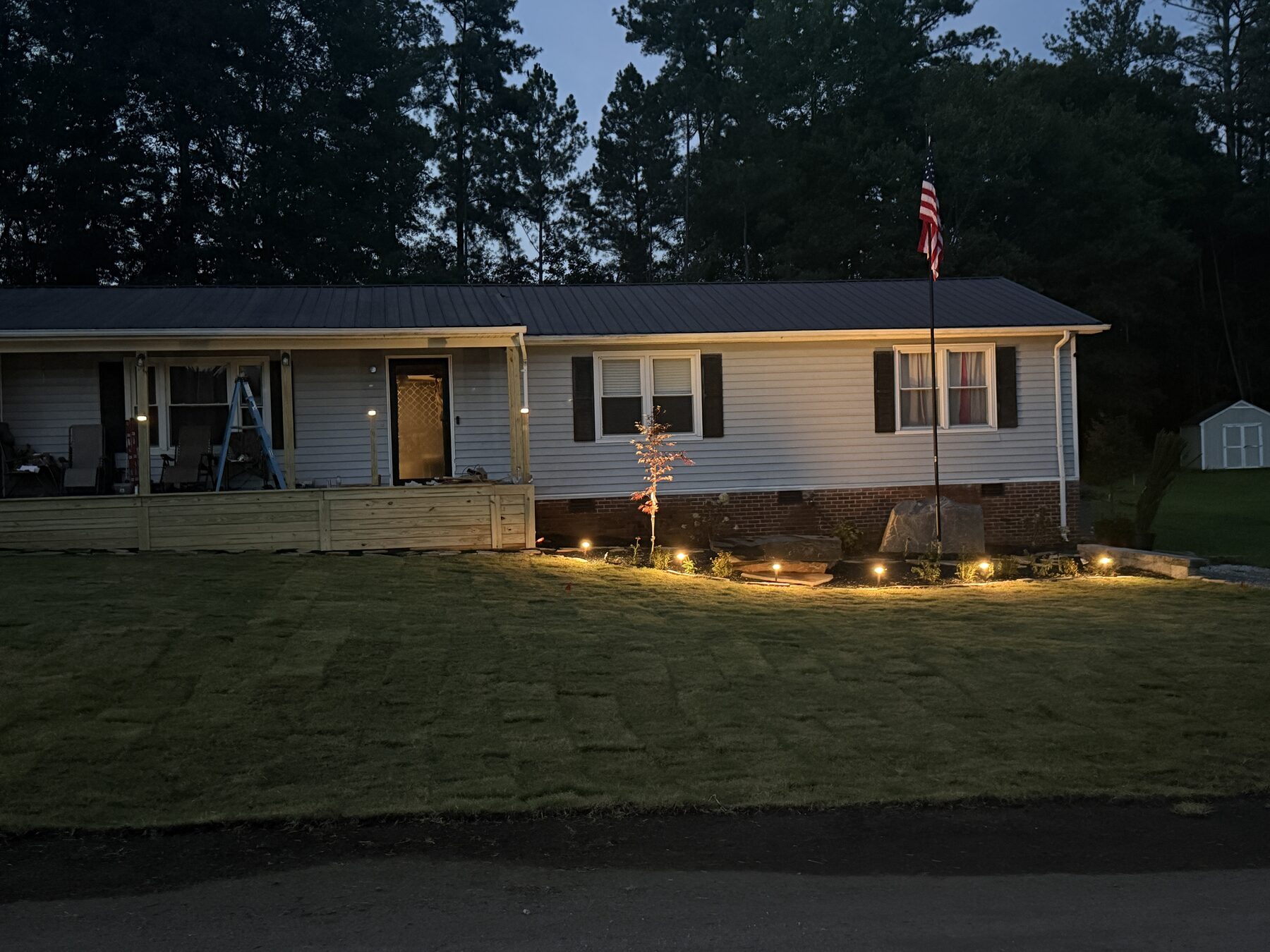
The short answer
← Swipe to see all columns
| Month | Tall fescue | Zoysia | Bermuda | What the job takes |
|---|---|---|---|---|
| March | Good | Dormant install | Dormant install | Warm-season roots wait for spring soil |
| April | Good | Workable | Workable | Warm-season just waking up |
| May | Good | Prime | Prime | Easiest installs of the year |
| June | Workable | Prime | Prime | Fescue needs committed irrigation |
| July | Workable | Prime | Prime | Fescue is all-in on watering |
| August | Workable | Good | Good | Heat is peaking; water daily |
| September | Prime | Good | Good | The best all-around month |
| October | Prime | Good → closing | Good → closing | Warm-season cutoff around mid-month |
| November | Prime | Roots in spring | Roots in spring | Fescue's best month |
| December | Good | Dormant install | Dormant install | We don't install warm-season here |
| January | Workable | Dormant install | Dormant install | Frozen ground is the only hard stop |
| February | Workable | Dormant install | Dormant install | Watch for winter drying |
These are our field windows for the Upstate, built on the extension guidance and local climate data cited throughout. Slope, shade, irrigation, and elevation move them a week or two either direction.
What the extension services actually say about timing
This is worth quoting directly, because it contradicts almost everything you'll read on a sod company's marketing page.
"Sod can be installed just about any time of year as long as the soil is not frozen and irrigation is available."
Virginia Cooperative ExtensionVirginia Tech Extension: "Sod can be installed just about any time of year as long as the soil is not frozen (for winter installations) and irrigation is available." (Virginia Cooperative Extension 418-040)
Mississippi State Extension: "Professionals lay sod year-round unless the ground is frozen or the fields are too wet to harvest." They go further on our cool-season grass — "Tall fescue should be installed in the fall or winter months to give it the best chance to survive the coming summer heat and humidity." (Mississippi State Extension)
NC State, Carolina Lawns — the closest extension guidance to our own climate: "You may successfully install a cool-season grass sod anytime in the cooler portions of the growing season when the ground is not frozen and anytime during the warmest times of the year with careful water management." On warm-season grasses laid outside the April–July window: "Professional sod installers have been successful in establishing lawns beyond those dates, but care must be given to ensure that the soil does not dry out." (NC State Extension, Carolina Lawns)
Kansas State: a cool-season lawn "can be sodded… anytime during the growing season provided adequate irrigation water is available." (K-State Turf)
Notice the pattern. Four different universities, four different climates, and every single one attaches the same condition — not a date. Water.
Clemson's own guidance names the two best seasons but doesn't close the door either: "It is best to lay during mid-late Spring or in the fall season," with fall work "completed early enough to allow root growth into the underlying soil before cold weather arrives" (Clemson HGIC, Lawn Establishment).
So what does temperature actually change?
Not survival. Rooting speed.
A pallet of sod is a harvested mat of grass with most of its root system cut off. From the moment it's laid, it is entirely dependent on you for water until it grows new roots into the soil underneath. Everything about timing comes back to how long that dependency lasts.
Purdue Extension puts the normal case at "10 to 14 days if temperatures are optimal and the sod is kept moist" (Purdue Extension AY-28-W).
Now push the temperature to either end:
Too hot. Purdue: "Lawns sodded in the heat of summer (when temperatures exceed 90°F) may not grow any new roots until air and soil temperatures cool." Turfgrass researcher James Beard documented why — cool-season root growth ceases around 77°F soil temperature, with optimum root growth at 50–65°F (Beard, Turfgrass Root Basics).
Too cold. NC State gives the number for warm-season grasses: "Sod will not produce roots unless the soil temperature exceeds 55°F for several weeks" (NC State Extension).
Sod will not produce roots unless the soil temperature exceeds 55°F for several weeks.
NC State Extension · Carolina LawnsIn both cases the sod isn't killed by the temperature. It just stops rooting — which stretches that window of total dependence from two weeks into two months, or all the way to spring. And the longer it can't feed itself, the longer you can't miss a watering.
That is the entire mechanism. Sod laid in July on an irrigated site thrives. The same sod on a neglected site is dead in three weeks — and would have shrugged off the same neglect in October.
Why fall is genuinely the best of it
Ask a sod farmer around here when to lay grass and you won't hear spring. You'll hear fall — because even after the top of the plant quits growing, the roots keep working.
They're right, and the numbers back them.
Beard's research puts cool-season root growth at its optimum between 50 and 65°F soil temperature, and warm-season root growth at 75 to 85°F (Beard). Texas A&M's turfgrass program adds that root activity in warm-season grasses continues down to roughly 50°F soil temperature (Texas A&M AgriLife, Dormant Sod).
Now look at what Upstate dirt is actually doing. The South Carolina State Climatology Office logs 4-inch soil temperatures across the state, and in the second week of November, Clinton — right here in the Piedmont, in Laurens County — read 55°F at a 4-inch depth (SC State Climatology Office).
Fifty-five degrees in November, weeks after the first frost has browned everything on top. That's sitting inside tall fescue's optimum rooting range, and still above the floor where warm-season roots quit.
Mississippi State names the other half of fall's advantage plainly: "An advantage to laying during cooler months is that less water is required," because cooler temperatures come with "timely rainfall and less evaporation" (Mississippi State Extension).
That's the whole case for fall. Roots are working, the plant isn't demanding water it can't get, and the margin for a missed watering is the widest it will be all year. The farmers have been describing this from forty years of watching it happen. The research just says it in degrees.
Tall fescue: the widest window of the three
Prime: September through November. Workable: year-round with irrigation.
Fescue is the cool-season grass in an Upstate yard, and fall is unambiguously its season — Upstate soil sits in its 50–65°F root-growth range straight through October and November, and it never fully goes dormant here the way zoysia and bermuda do.
It's also the grass with the fewest hard limits. NC State permits cool-season sod "anytime during the warmest times of the year with careful water management," and Mississippi State recommends fescue installation in fall or winter. Summer fescue is not off the table — it's just the most demanding install we do, and we won't take one without irrigation on site.
Once it's rooted, mow at 2½ to 3½ inches, never removing more than a third of the blade (Clemson HGIC, Tall Fescue Maintenance Calendar).
Fescue also carries good shade tolerance where bermuda rates very poor (Clemson HGIC, Turfgrasses for the Carolinas). Under mature hardwoods — half of Greenville — this is usually the answer regardless of month.
Zoysia: prime in summer, closes around mid-October
Prime: May through early August. Fall cutoff: around October 15.
Zoysia is an excellent Upstate grass. Clemson rates its cold hardiness very good — better than bermuda, better than tall fescue — and its shade tolerance excellent (Clemson HGIC). It's also almost always installed as sod, since only two cultivars are available as seed at all. If you're deciding between the two varieties we install most, our Zeon vs. Empire Zoysia comparison breaks down shade tolerance, blade feel, and how each handles red clay.
But cold hardiness in an established lawn and rooting of a freshly laid pallet are two different questions.
Two things set the mid-October line. First, NC State's 55°F threshold: below that soil temperature, warm-season sod won't produce roots for several weeks — and Upstate soil crosses 55°F in early-to-mid November. Second, frost. The average first 32°F reading at the Greenville–Spartanburg Airport is October 17; Clemson averages October 13, Anderson October 16 (SC State Climatology Office, Freeze/Frost Data).
Sod laid four to six weeks ahead of frost has time to grip. Sod laid the week of Halloween is going into winter sitting on top of the ground rather than anchored in it — which is survivable, but it's a different job with different rules.
Zoysia is also the warm-season grass most often flagged for late-season risk. University of Georgia Extension reports that zoysiagrass and centipedegrass show greater winter injury than bermudagrass when installed late in the season (UGA Extension) — a pattern Georgia horticulturist Walter Reeves reports as well (Walter Reeves).
One trap to avoid: don't let anyone push nitrogen into fall warm-season sod to "help it establish." Clemson's rule for the Upstate is no nitrogen on warm-season lawns after August 15, partly to avoid feeding large patch disease, which hits zoysia hard in fall (Clemson HGIC, Large Patch). UGA says hold nitrogen until spring, when soil reaches 65°F at a 4-inch depth. Lime and phosphorus corrections from a soil test are a different matter and go in before the sod does.
Bermuda: the most forgiving late install
Prime: May through August. Fall cutoff: around October 20.
When a project is running behind and the calendar is tight, bermuda is the warm-season grass we're most comfortable putting down late. Both UGA Extension and Walter Reeves identify bermudagrass as the most winter-hardy option for late-season and dormant installations.
Bermuda also establishes fastest of the three, which is what you want when rooting time is short. The tradeoff is sun: Clemson rates bermuda's shade tolerance very poor, with only the TifGrand cultivar tolerating meaningful shade (Clemson HGIC). Bermuda under trees fails for reasons that have nothing to do with what month it went down.
Expect it to brown out after the first hard frost. That's dormancy, not failure — the roots keep working until soil temperatures reach about 50°F.
December through February: the one window we sit out
We install eleven months a year. We don't schedule warm-season sod in December, January, or February, and we'll tell you why rather than pretend it's impossible.
That's the dormant sodding window, and it's a real technique — it's used specifically for erosion control on bare lots that can't wait. But the risk profile changes completely.
Clemson is blunt about winter installs: "Conditions for root growth are not favorable. The grass may or may not survive the winter, depending on temperatures" (Clemson HGIC). Purdue's assessment is the fairest one-liner in the literature: "Dormant sodding can be successful but is more risky than fall sodding due to the increased risks of winter desiccation and injury" (Purdue AY-28-W).
And here's the counterintuitive part — the cold itself usually isn't the killer. Drying out is. Texas A&M reports dormant grass can desiccate in a single day under warm, dry, windy winter conditions. UGA's turfgrass specialist says the same: "In as little as a day, turfgrass that has an undeveloped root system can desiccate." Virginia Tech flags exactly the mistake homeowners make — "it is especially easy to forget that a straw-colored, dormant warm-season sod might still require supplemental irrigation, even in the dead of winter."
Worth knowing: dormancy by itself is not fatal. Researchers at the University of Arkansas planted Tifway bermuda and Meyer zoysia at dormant, spring, and summer dates and found dormant planting performed as well or better — zoysia sprigged dormant reached full cover in the first season while spring and summer plantings did not (Zhang, Richardson et al., HortTechnology, 2021).
Read that carefully before you lean on it. Their dormant planting date was late March — dormant with warming weather ahead. A December install is dormant with three months of cold ahead. Opposite trajectory. The study proves dormancy isn't the enemy; it does not make a December install a safe bet.
If we do install dormant, this is how
- Fresh sod, laid fast — within 24–48 hours of harvest, kept tightly stacked and rolled if delayed
- Tight, staggered seams, rolled immediately
- Topdress the seams with sand to fill gaps, conserve moisture, and hold surface heat
- Keep the top 1–2 inches of soil moist, never saturated — total water from rain plus irrigation capped around ¾ to 1 inch
- Never irrigate at or near freezing — roots can't take up water then and you're doing harm
- No nitrogen, no pre-emergent — both work against rooting
- Watch it into spring, because winter injury often doesn't show until green-up
If you have the choice, wait for March. If a builder handed you a raw slope in December, this beats watching your topsoil end up in the street.
What actually makes sod fail
After all of it, here's the honest list — and notice that only one item is about the calendar.
1. Nobody watered it. This is the big one, and every extension service in the Southeast says so in different words. Purdue names inadequate irrigation — "especially to sod edges" — among the most common mistakes.
2. The grade was wrong. Sod laid over a low spot, a negative grade toward the foundation, or compacted construction subsoil fails on schedule regardless of month. In Upstate red clay this is most of the job.
3. The soil was never prepared. Clemson calls for a soil test two to three months ahead, deep tillage to break compaction, roughly an inch of incorporated organic matter, and lime and fertilizer to the test results (Clemson HGIC). UGA recommends tilling 3 to 4 inches deep.
4. The pallet sat too long. Sod is perishable, and this matters more than the season does. An Oklahoma State study stored Tahoma 31 bermuda and Meyer zoysia for up to 96 hours before installing; the bermuda discolored completely but resumed growth within two weeks, and the zoysia recovered within one (Oklahoma State Extension, Mingying Xiang). Resilient — but that's four days of damage you don't need to buy.
5. Wrong grass for the site. Bermuda in shade. That's a selection problem wearing a timing problem's clothes.
6. Wrong month for the level of care available. Last on the list, not first.
Watering new sod: the part people get wrong
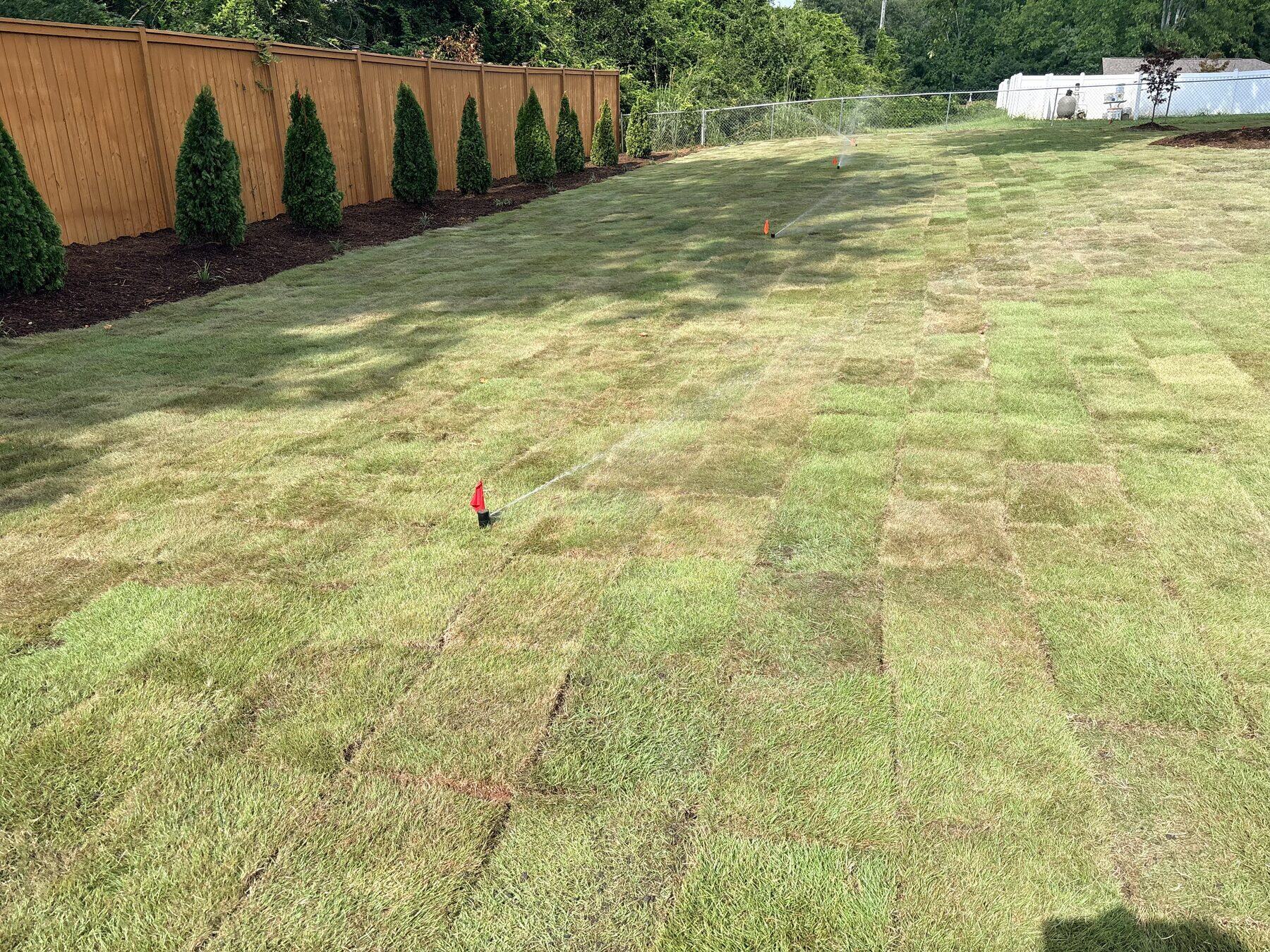
Clemson's schedule is specific, and it isn't what most homeowners do:
- Immediately after laying, water enough to wet the soil to a 4-inch depth. Not the sod — the soil under it.
- Water daily to keep that top 4 inches moist until the sod roots into the ground beneath.
- Then transition to lighter midday applications until the sod-to-soil union is fully knit.
- Don't mow until the sod is firmly rooted and won't shift under the mower. (Clemson HGIC)
Virginia Tech adds the hot-weather version: above 80°F, "water the sod daily, wetting the soil thoroughly until the sod is well-rooted" (Virginia Cooperative Extension).
One note for this year in particular: don't count on fall rain to do the work. Greenville County came through the 7th driest January–July in 132 years of records, running 10.91 inches below normal (NIDIS / drought.gov). Soil went into this fall with a real moisture deficit. New sod this season needs water put on deliberately.
Once a warm-season lawn is established, the rule flips — Clemson recommends watering warm-season lawns no more than once per week in fall, because overwatering feeds large patch (Clemson HGIC). New sod is the exception, not the rule.
Grade first. Always.
None of these windows matter if the sod is going down on a yard that holds water.
Water doesn't soak into compacted Upstate clay — it runs across it, and it runs to the lowest point on your property. Laying sod before correcting that is paying for the same lawn twice.
This is why we sequence the whole job together: correct the grade, get drainage in, then lay sod — so it's all in place before the wet season rather than during it. That's our land grading and leveling work and our sod installation work done as one project by one crew, and if you want to know what the grading half typically runs, we published real Upstate numbers in what land grading costs in Greenville.
When we'll tell you to wait
We'd rather turn down a job than install something we expect to fail. We'll recommend waiting when:
- It's past late October and you want zoysia. Bermuda or fescue is the better call, or hold the zoysia for spring.
- The yard hasn't been graded and water is still running the wrong direction. Fix the cause first.
- There's no way to water it. This is the real disqualifier, in any month.
- The area is heavily shaded and the request is bermuda. That's a grass problem, not a timing problem.
- It's December through February and the job isn't urgent. March is close enough to be worth the wait.
The bottom line
Sod is not a seasonal product in the Upstate. With unfrozen ground and water available, it goes down nearly year-round — and the extension services say so plainly.
What changes month to month is how fast it roots and how much care that costs you:
- Fescue — prime September through November, workable year-round with irrigation
- Zoysia — prime May to early August, fall cutoff around October 15
- Bermuda — prime May through August, fall cutoff around October 20, most forgiving late
- December through February — dormant sodding, useful for erosion control, real risk disclosed up front
So if you're sitting there in October wondering whether you've missed it: you probably haven't. Ask about the grass and the water, not the month.
Iron Lungs Grading & Landscape Construction installs fescue, zoysia, and bermuda sod across Greenville, Spartanburg, Anderson, Pickens, and the surrounding Upstate — and we grade and drain the site before we lay a single pallet. Tell us the grass, the slope, and the shade, and we'll give you a straight answer about whether to go now or wait. See our full sod & landscape installation page, or call (864) 238-4448.