Isaias Is About to Show You Where Your Yard Drains Wrong —
Here's What to Watch For This Weekend
Every drainage call we get in Greenville, Simpsonville, and Spartanburg starts the same way: "It only does this when it rains hard."
This weekend it's going to rain hard. Fox Carolina's First Alert team is forecasting 1 to 3 inches across the region from Isaias's remnants, with 3 to 4 inches near the Blue Ridge Escarpment where the upslope lift wrings extra water out of these systems. Wind gusts of 25 to 30 mph both days, and a flash-flooding risk wherever the heaviest bands set up (Fox Carolina, Oct. 7). WBTV's Charlotte forecast has the moisture arriving late Saturday and continuing much of Sunday, with the heaviest totals toward the mountains (WBTV, Oct. 7).
Here's the thing nobody says about a storm like this: it's the best drainage inspection your yard will ever get, and it costs nothing. We can walk a dry yard and tell you a lot. But a yard in the middle of a two-inch rain tells you everything — where water collects, where it runs, where it's eating the soil, and whether it's headed toward or away from your house.
This guide is how to read it. Ten minutes Friday, a few looks out the window Saturday night and Sunday, and one walk Monday morning. By Monday you'll know more about your property than most homeowners learn in ten years.
Why this rain will tell you more than most
Two things make this weekend unusual.
First, the ground is in bad shape to receive it. Greenville County is coming off the 10th driest January-through-August in 132 years of records, running 10.99 inches below normal (NIDIS / drought.gov, Greenville County). August was wetter and we picked up rain last weekend, but the subsoil hasn't caught up — 87% of the county's population is still flagged as drought-affected.
Second, Upstate clay was never good at taking on water quickly. Cornell University's soil hydrology reference puts the steady infiltration rate of clay and silty clay loam soils at less than 0.2 inches per hour (Cornell NRCCA, Soil Hydrology). Bare soil, they note, "may easily develop crusts" that cut that number further — and dry, crusted clay is exactly what a lot of yards are sitting on right now.
Do the math. When a tropical band drops rain at an inch an hour onto ground that can absorb two-tenths of an inch an hour, roughly 80% of that water has to go somewhere else. Across your lawn. Down your driveway. Against your foundation. Into your crawl space. Onto your neighbor.
That's not a design flaw in your yard. It's physics. The question this weekend answers is where the water goes — and whether that's a problem.
One note on scale: this is not a Helene situation, and the meteorologists have been clear about that. Isaias's rain comes in from the west rather than driving straight into the mountains off the coast. Think of this as a hard, useful rain — the kind that reveals problems, not the kind that creates them.
Before the rain: the 10-minute Friday checklist
None of this is a repair. It's making sure the water you're about to watch is behaving honestly — so a clogged gutter doesn't fool you into thinking you have a grading problem.
- Clear the gutters and downspout outlets. A 2,000-square-foot roof sheds about 1,250 gallons of water per inch of rain — roughly 3,700 gallons if you get three inches. All of it exits through four or five downspouts. Make sure they're open.
- Check where each downspout discharges. It should carry water several feet from the foundation. A downspout that dumps at the corner of the house is the single most common "drainage problem" we see, and the cheapest to fix.
- Pull leaves off yard drain grates, catch basins, and culvert openings. Early-October leaf drop is already clogging them.
- Walk any swales, ditches, or channels along your property line or driveway and clear what's blocking them.
- Take photos of the yard dry — the same angles you'll shoot wet. Low spots, the foundation line, the driveway, any bare soil.
- If you have bare, freshly graded, or recently seeded soil, know that it's going to move. Note where it is so you can see what happened.
During the rain: the five things to actually watch
You don't need to stand in it. Look out the window during the heaviest stretch Saturday night, and again Sunday. Phone video of each spot, 20 seconds, same place each time.
1. The foundation line
This is the one that matters most. Look along the base of the house. Is water visibly moving away from the foundation, or standing against it — or running toward it?
The residential building code standard, IRC R401.3, requires the ground around a foundation to fall at least 6 inches within the first 10 feet away from the house. Where lot lines or slopes make that impossible, the code allows swales or drains to redirect the water instead (IRC R401.3, via InterNACHI). If water is pooling against your foundation during this rain, your grade has failed that standard. That's a crawl space or slab problem waiting to happen, not a lawn problem.
2. Where water collects first, and how big it gets
Every yard has low spots. Watch which ones fill, in what order, and how large the puddles grow. A small puddle that appears late in the storm is a minor low spot. A sheet of water that forms in the first twenty minutes and keeps spreading is a grade directing water to the wrong place.
3. Where water is running
Standing water tells you about grade. Running water tells you about volume and path. Look for channels forming across the lawn, water sheeting down the driveway, a stream along the fence line, or flow coming onto your property from uphill — a neighbor's yard, the street, a drainage easement. Note the direction.
4. The downspout outlets
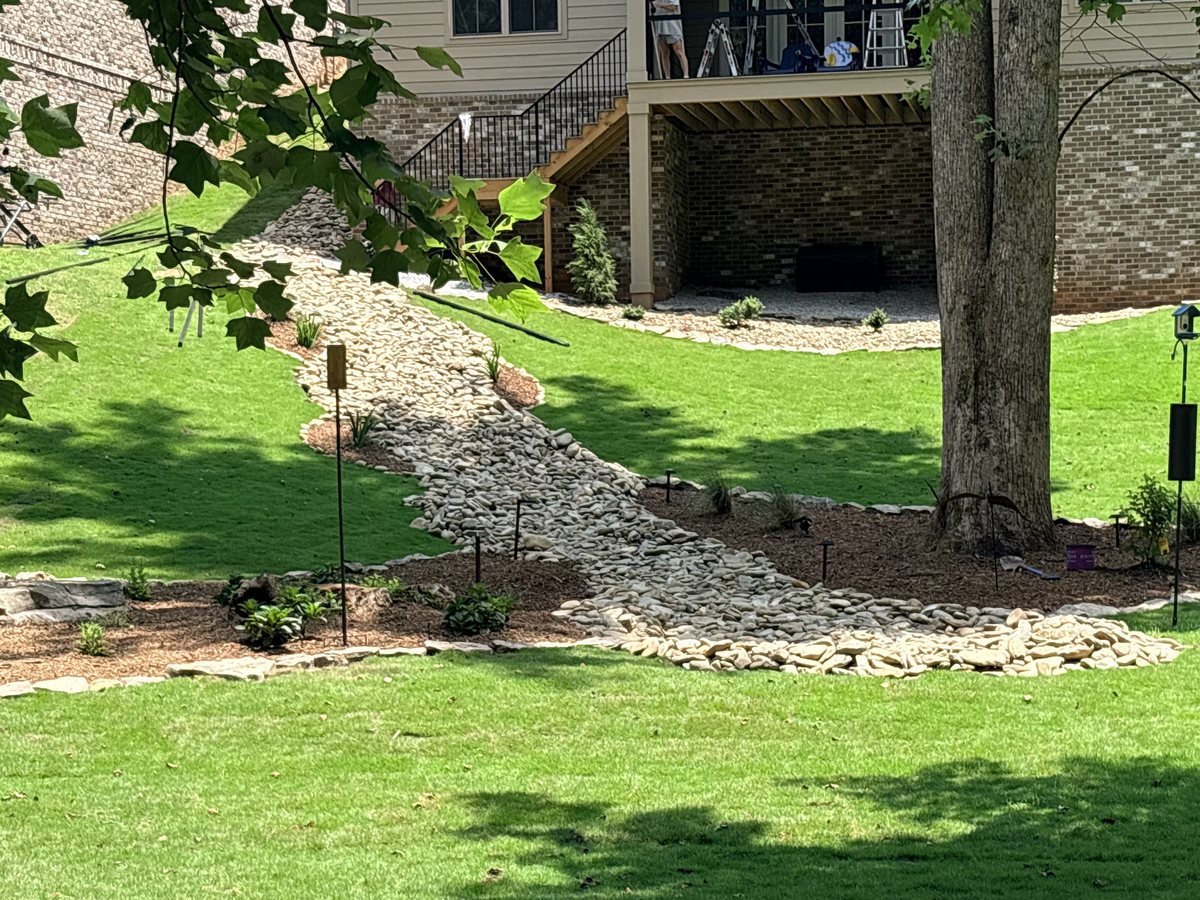
Go back to the downspouts you cleared Friday. Is the water actually getting away from the house, or pooling right there at the corner and soaking down along the foundation? If it's pooling, that corner is where your crawl space moisture is coming from. We route a lot of downspouts into buried drain lines or onto river rock outlets for exactly this reason.
5. The color of the water
Clear runoff means water is moving over the surface without taking anything with it. Brown, muddy runoff means soil is leaving your property. That's erosion happening in real time — on a slope, a bare bed, a construction cut, a driveway edge. Watch where the muddy water is coming from, not just where it's going. That's erosion control territory, and the earlier it's caught the smaller the job.
After the rain: the Monday morning walk
This is the step most people skip, and it's the most useful one.
The rain should be done by Monday. Walk the yard Monday morning and look for what's still standing. Clemson's rain garden manual — written to help South Carolina homeowners find soil that absorbs water — sets the bar plainly: water should drain within 24 hours. Anything slower, they say, is a site to treat as wetland rather than lawn (Clemson Extension, Rain Garden Manual). Iowa State Extension puts a number on it: soils that drain less than one inch per hour have poor drainage (Iowa State Extension).
So: any water still sitting in open lawn Monday morning — roughly 24 hours after the heaviest rain — is telling you something a dry-day inspection never could. Mark those spots. Walk them and feel for soft, spongy ground. Photograph them from the same angles as your dry photos.
Then, if you want a real number, run the test both extension services describe: dig a hole about 6 inches wide and 12 inches deep in your worst spot, fill it with water, let it drain completely, fill it again, and time it. Under 6 hours to empty is quick-draining soil. 6 to 12 is standard. Approaching 24 is slow. Over 24 hours, you don't have a drainage issue — you have a drainage situation, and no amount of topsoil or grass seed is going to fix it.
Most of the standing-water calls we run in Greenville County come down to one of three things: a downspout dumping at the foundation, a low spot that was never graded out when the house was built, or compacted construction subsoil under a thin layer of topsoil that never had a chance. The first one is cheap. The other two are grading work. All three are visible during a hard rain and nearly invisible on a dry day — which is why we'd rather you watch this weekend than call us in June and try to describe it.
What the results mean
Here's how we'd read what you saw.
| What you observed | What it usually means | The fix |
|---|---|---|
| Puddles gone within 6 hours | Normal clay behavior | Nothing — your yard drains fine |
| Standing water in open lawn after 24 hours | Low spot, compaction, or both | Regrade and fill, or correct the slope |
| Water against the foundation, or flowing toward it | Grade fails the 6-in-10 standard | Regrade the perimeter; swale or drain where regrading isn't possible |
| Downspout corners pooling | Discharge too close to the house | Extensions or buried drain line to daylight |
| Muddy runoff from a slope or bed | Active erosion | Stabilize the slope, redirect the water, or both |
| Channels cut across the lawn | High volume on the wrong path | Swale, berm, or French drain to intercept and redirect |
| Water arriving from uphill or a neighbor | Not your water, but your problem | Interceptor swale or drain at the property line |
| Driveway rutting or washing | No crown, no culvert, or clogged culvert | Regrade with proper crown; add or clear drainage |
Swipe to see the full table →
Based on what we see on Upstate drainage calls. Your yard may show more than one of these at once — the foundation line always comes first.
Some of these a handy homeowner can handle: downspout extensions, clearing a culvert, filling one shallow low spot. The ones involving the foundation line, a slope that's actively losing soil, water arriving from off your property, or a gravel driveway that washes every storm are grading and drainage work. The sooner they're corrected after you've seen the problem, the easier they are to get right.
Why this is the start of drainage season, not the end of it
Here's something most people get backwards: winter is the best time to fix drainage in the Upstate.
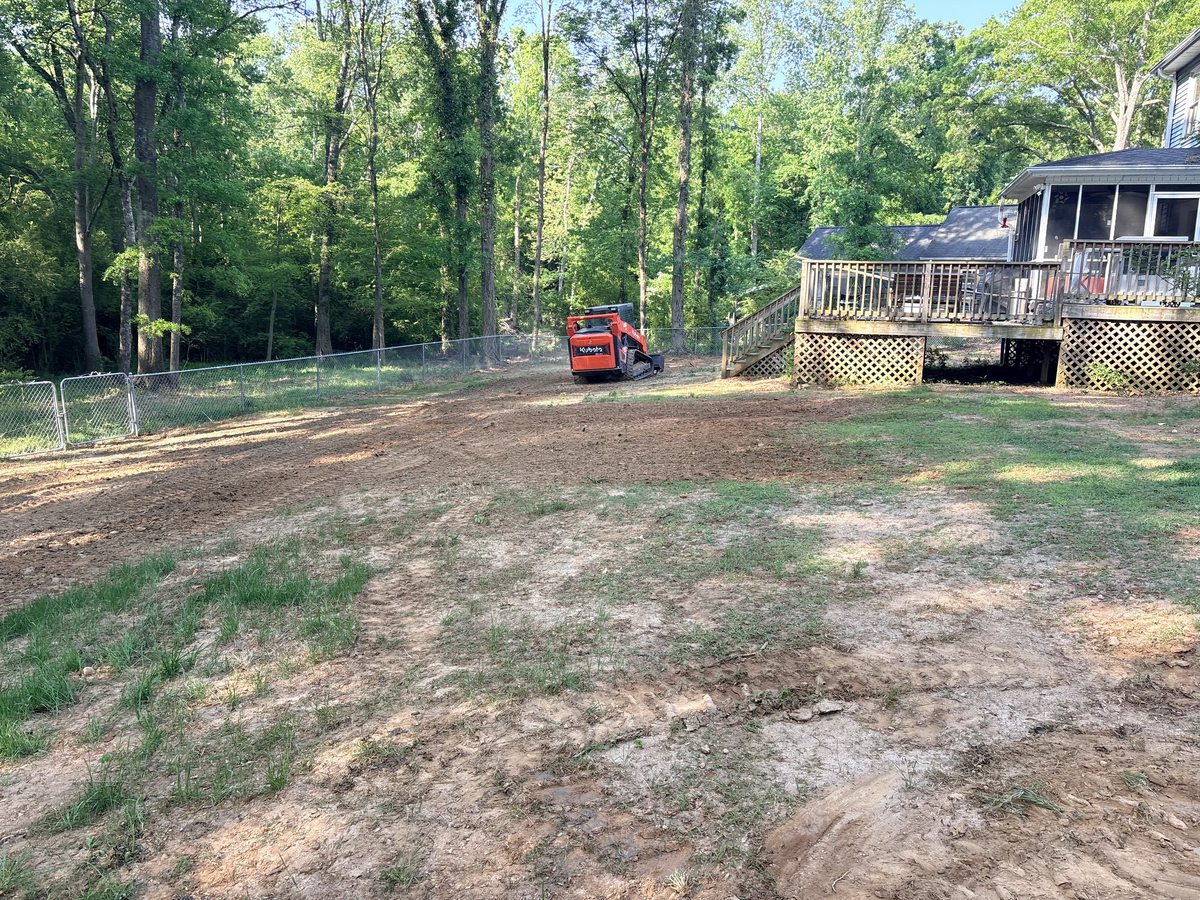
It sounds wrong. But think about what you're about to do this weekend — watch water move across your yard and learn where the problems are. That only works when it's raining. From now through late winter, the Upstate gets its steadiest rain, the grass goes dormant so you can see the ground, and the leaves come off the trees so you can see the slopes. Every problem your yard has is visible. In June, with the lawn thick and the ground dry, the same yard hides everything.
That visibility is what makes winter drainage work better work. We can see the actual flow paths instead of guessing at them. We can watch a fix handle a real rain before we leave. And with turf dormant, there's less to tear up getting equipment to the problem.
So treat this weekend as the preview. If Isaias shows you something, the next four months are when to get it corrected — not next spring, when the evidence has grown over and the wet season is already behind you. If you're wondering what the work runs, we've already written up what land grading and drainage correction cost in Greenville in 2026, by project type.
The bottom line
Isaias isn't going to do anything to your yard that the next hard rain wouldn't. What it will do is show you — this weekend, on your own property, in real time — exactly where your water goes.
Clear the gutters Friday. Watch five things Saturday night. Walk it Monday morning. Take photos the whole way — you'll want them whether you fix it yourself or have someone out to look.
Then, if what you saw worries you, that's what the assessment is for. We'll walk the yard, tell you honestly whether it's a downspout extension or a grading job — and if it's the latter, winter is exactly when we want to be doing it.
Iron Lungs Grading & Landscape Construction corrects grading, installs French drains and buried drain lines, builds swales and berms, regrades gravel driveways, and controls erosion across Greenville, Simpsonville, Greer, Taylors, Travelers Rest, Mauldin, Spartanburg, Anderson, Pickens, and the surrounding Upstate. See our land grading & drainage and erosion control pages, or call (864) 238-4448.