River Rock vs. Mulch in Greenville, SC:
What Your Beds Really Cost Over 10 Years
Every spring in Greenville the same thing happens. The mulch has faded to gray. It's thin along the edges. Weeds are pushing through, and the house just doesn't look as sharp as it did last April. So you call for another load — and you'll do it again next year, and the year after that.
We install both mulch and river rock across Greenville County, and we're not going to tell you mulch is bad. It has real benefits, and there are beds where we'll steer you toward it. But most homeowners only look at the price on the first invoice, not at what the beds will cost over the next decade. When you run the actual numbers, river rock isn't the expensive option. It's the option you pay for once.
The dollar figures in this guide are the general numbers we quote in the Upstate: roughly $100 per cubic yard for mulch, installed, and roughly $300 per ton for river rock, installed. Every job moves a little — how far material has to be carried, slope, access, edging, and prep all matter — so treat these as planning numbers, not a quote. Everything else in this guide about how fast mulch breaks down comes from university extension services, peer-reviewed research, and the South Carolina State Climatology Office, and each claim is linked.
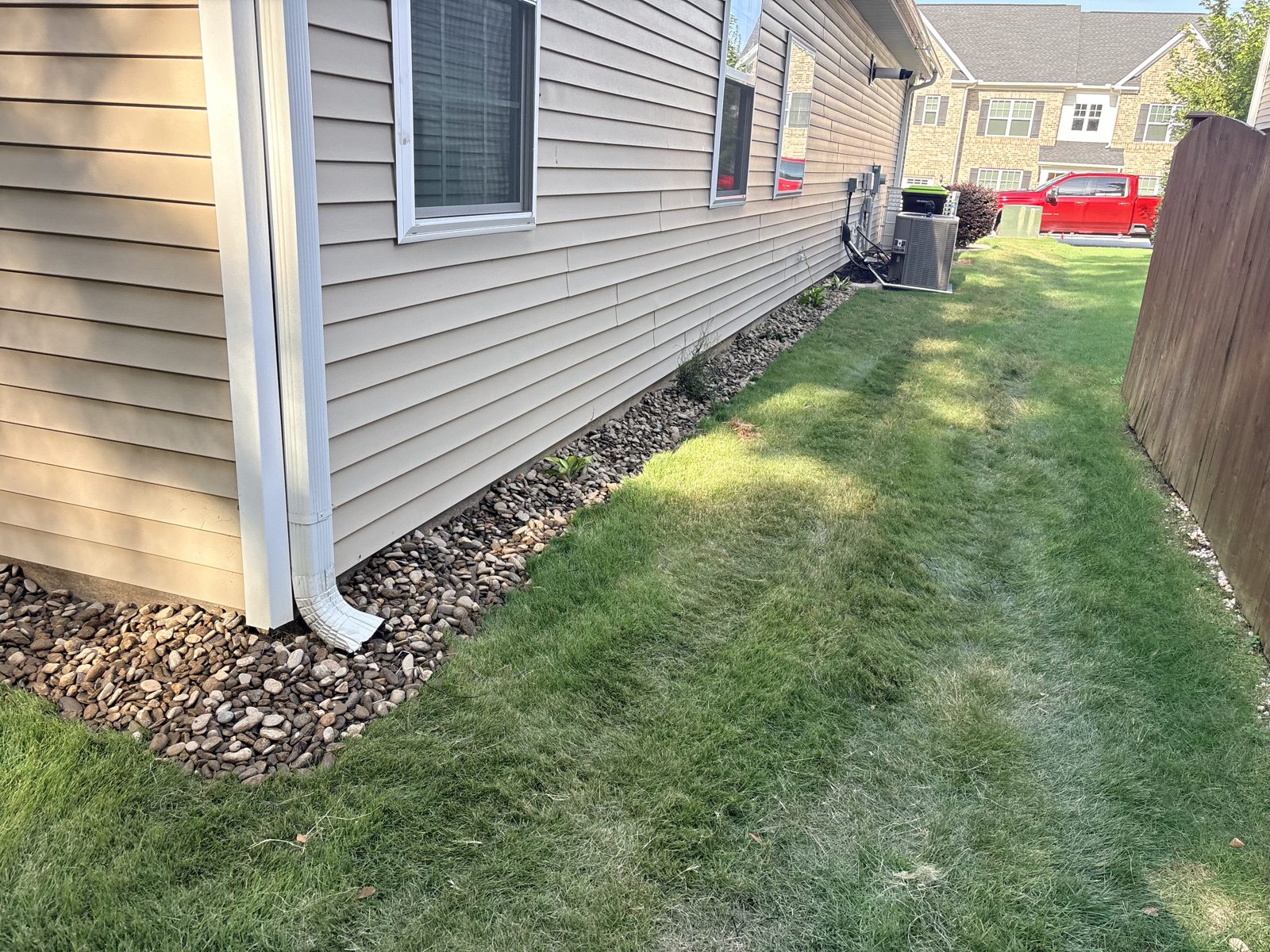
Why mulch disappears faster in the Upstate than almost anywhere else
Wood mulch — hardwood, pine bark, cypress, dyed — is organic material. The moment it hits the ground, soil microbes, fungi, and insects start turning it into compost and, eventually, soil. That's not a flaw. It's what mulch is designed to do. But it means every load you buy is temporary by definition.
How fast it goes comes down to two things: temperature and moisture. A July 2026 review in Frontiers in Agronomy summarizes decades of soil-crop modeling and confirms that mulch decomposition rates are governed by soil temperature and soil water content, with microbial activity speeding up as both rise (Willemet et al., 2026). The same review notes that woody, high-carbon mulches tie up nitrogen in the soil as they break down — a process called nitrogen immobilization — which is part of why plants in a freshly mulched bed can look a little hungry.
Now look at where we live. The South Carolina State Climatology Office puts Greenville County's average precipitation at 50.73 inches a year (1991–2020 normals). The same office's 2024 Year in Review ranked 2024 the fifth-warmest year on record statewide, recorded 101°F at GSP on July 5, and logged six to eighteen inches of rain across the Upstate from Hurricane Helene in a single event.
Hot plus wet equals fast decomposition. That's not an opinion. It's the biology of the material.
Our own state experts say the same thing. Clemson's Home & Garden Information Center notes that wood chips decompose "within 2 years," and even the slowest options like pine bark nuggets only last "around 2 to 4 years before the need to add more" (Clemson HGIC). That guidance is written for the whole state. In the foothills, where we get more rain than the Midlands or the coast, expect the short end of those ranges — and expect the color and the finished look to be gone long before the material is.
The national maintenance guides land in the same place. LawnStarter's 2026 replacement guide specifically calls out South Carolina's "intense climate," where weathering and decomposition happen "much faster than in cooler U.S. climates," and notes that Southeast homeowners commonly replace mulch once or even twice a year (LawnStarter, Feb 2026). Angi's March 2026 cost guide puts it plainly: mulch "breaks down over time, so you'll need to replenish it annually or every other year," typically adding one to two inches each season (Angi, Mar 2026).
In other words, when you buy mulch in Greenville you're not buying a landscape material. You're signing up for a subscription.
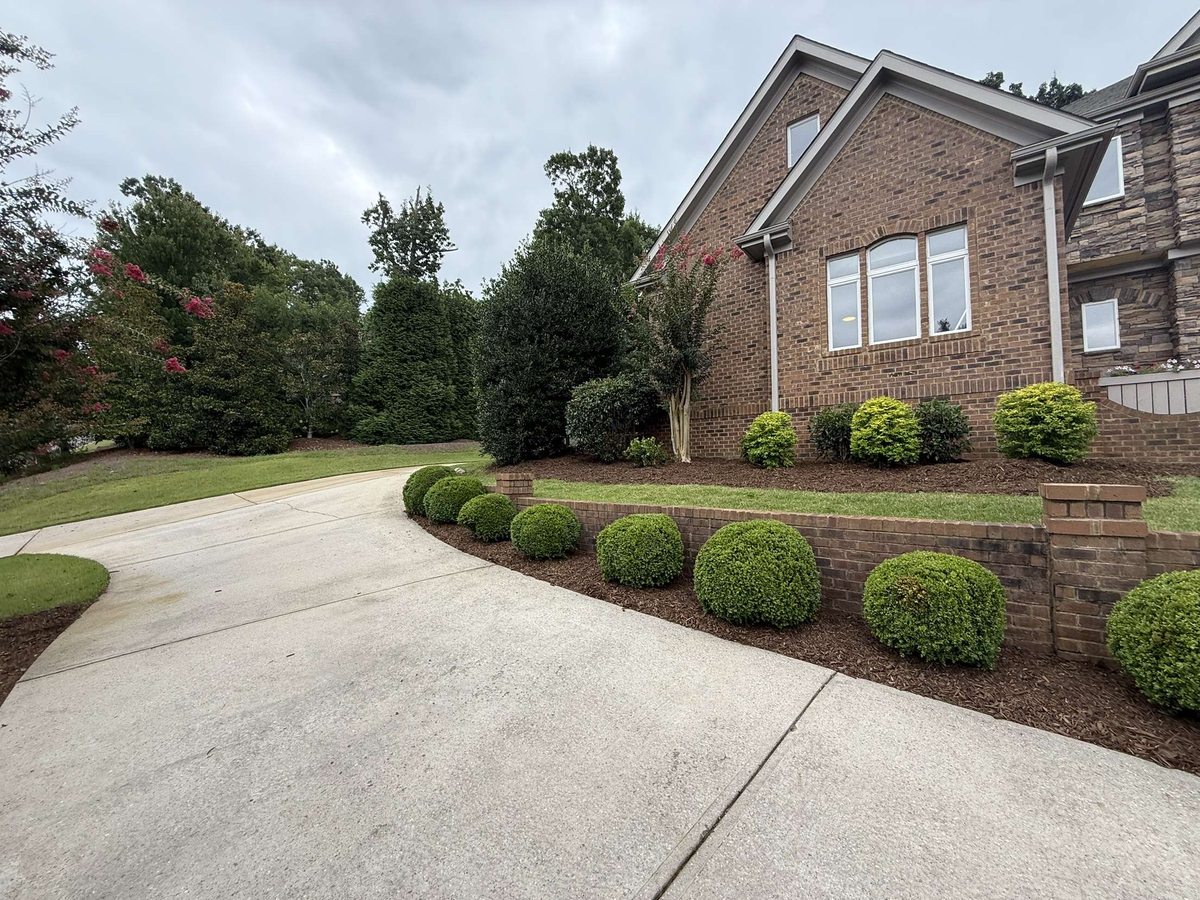
What river rock does differently
River rock is inorganic. Microbes don't eat it. Rain doesn't dissolve it. Summer sun doesn't fade it. Virginia Cooperative Extension's November 2025 mulching guide describes inorganic mulches like stone as materials that "stay in place and last a long time, even permanently" (Garrity & Tierney, 2025). Clemson classifies gravel and stone as "permanent" mulches that need "little to no replacement," and adds that a layer as thin as one inch gives good weed control. LawnStarter's 2026 guide lists stone at a 10-plus-year lifespan against roughly one year for wood chips and bark.
That difference in lifespan is the whole story. One product has to be bought again every twelve months. The other has to be bought once.
The real numbers: mulch vs. river rock on a typical Greenville bed
Take a standard foundation bed of 500 square feet — a bed ten feet deep running fifty feet along the front of a house. Here's what each option costs using our general pricing.
Mulch, year by year
- Initial install at 3 inches: about 5 cubic yards → $500
- Annual refresh at 2 inches (the middle of Angi's 1–2 inch guidance): about 3 cubic yards → $300 per year
- Year 5 cumulative: $1,700
- Year 10 cumulative: $3,200
- Year 15 cumulative: $4,700
That assumes mulch prices never go up. They do. It also assumes you never pay for a full strip-out when the old layer mats down and gets moldy — which, in our humidity, happens more often than people expect.
River rock, year by year
- Initial install at about 3 inches: roughly 6 tons → $1,800
- Years 2 through 15: $0 in replacement material
| Mulch | River Rock | |
|---|---|---|
| Upfront cost (500 sq ft) | $500 | $1,800 |
| Annual maintenance cost | ~$300 | $0 |
| 5-year total | $1,700 | $1,800 |
| 10-year total | $3,200 | $1,800 |
| 15-year total | $4,700 | $1,800 |
| What you do each spring | Order, schedule, spread | Blow off the leaves |
General estimates based on our typical Upstate pricing. Your quote depends on bed size, depth, rock size, prep work, and site access.
The break-even point
Mulch passes river rock in total spending somewhere between year five and year six. Every year after that, mulch costs more, and it never stops. Over ten years the mulch bed runs about $1,400 more than the rock bed. Over fifteen, about $2,900 more — on one bed. Most homes in Greenville have more than one.
What this means for your future, not just this spring
Think about what that recurring $300 a bed actually is. It's a bill that shows up every year you own the home. It's a scheduling task every spring, a delivery, and a weekend of work if you do it yourself. And when you sell, it gets handed to the next owner along with the keys.
River rock flips that. The year you install it is the last year that bed costs you material money. When you list the house, you're handing a buyer beds that don't need a $1,000-plus refresh to look right in the photos. With so many buyers moving to the Upstate from out of state, a yard that stays sharp without constant attention is a real selling point.
Where river rock wins
- Foundation beds and along the house. Rock doesn't rot against your siding, doesn't hold moisture against the foundation the way a thick mulch layer can, and doesn't invite termites and other pests the way wood does. Rock borders are one of our most-requested jobs for exactly this reason — see our gravel & rock installation page.
- Drainage areas and downspout outlets. Greenville gets 50-plus inches of rain a year plus storms like Helene. Mulch floats and ends up in the yard and the street. Rock stays put and lets water pass through.
- Slopes and hillsides. Same reason. Anyone with a sloped bed in Greenville has watched their mulch end up on the sidewalk after a summer thunderstorm. If a bed keeps washing out, the grade is usually the real problem — that's erosion control work, and rock is part of the fix.
- Beds with evergreens, ornamental grasses, and drought-tolerant plantings that don't depend on constant organic-matter inputs.
- Homeowners who are done with the annual mulch bill.
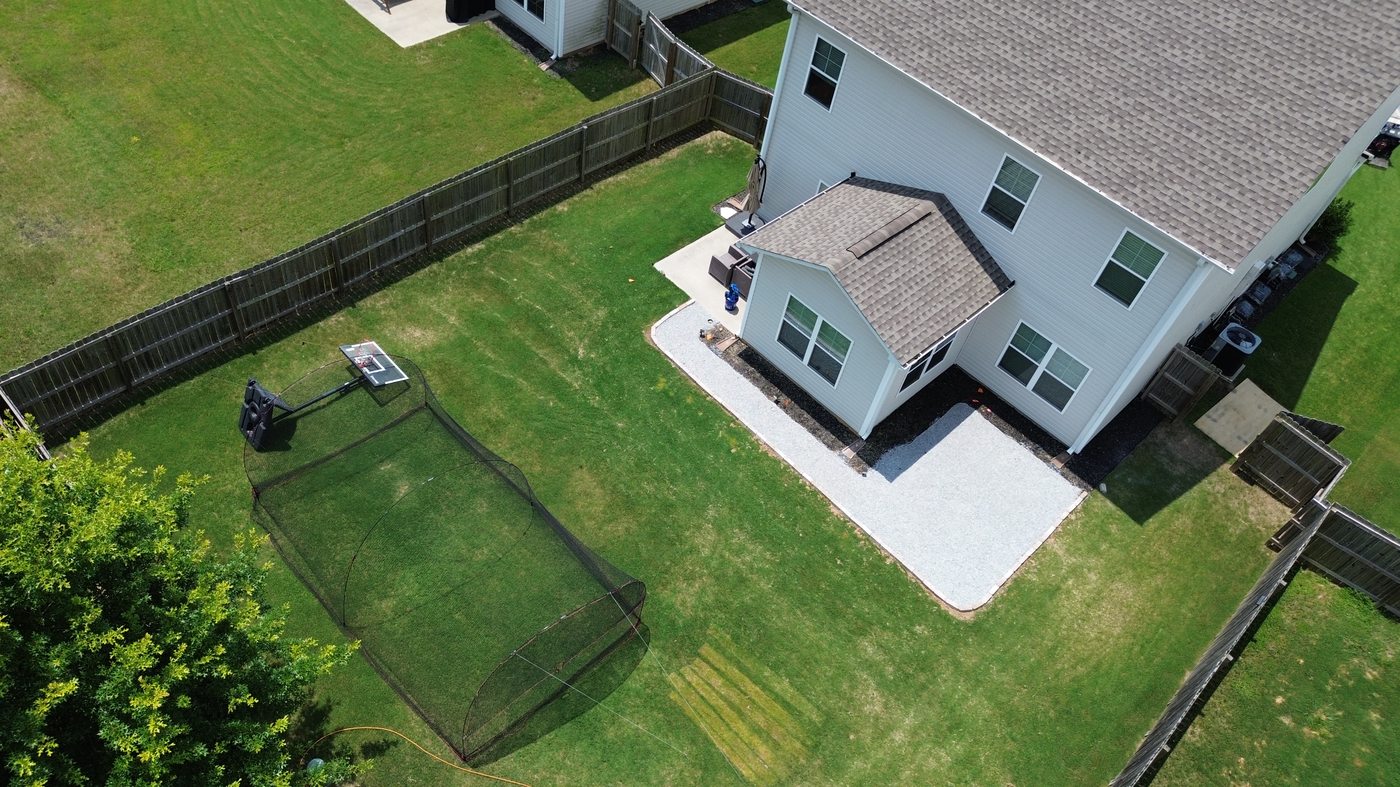
Where mulch still makes sense (yes, we'll tell you)
We'd be doing you a disservice if we said rock is right everywhere. The research is honest about the trade-offs, and so are we.
- Around acid-loving plants — azaleas, camellias, rhododendrons, blueberries — which are everywhere in the Upstate. Both Clemson and Virginia Cooperative Extension caution that some stone, particularly limestone-based gravel, can add alkaline elements and raise soil pH over time. River rock is generally more inert than crushed limestone, but we still talk through plant selection before we spec rock.
- Around young trees and in vegetable or perennial beds where you want organic matter feeding the soil. A 2024 study in Sustainability found organic mulches meaningfully increased soil moisture and water infiltration over three years (Rossi et al., 2024). That's a real benefit if the goal is building soil, and it's why we mulch new plantings from our native plant guide rather than rocking them.
- Heat-sensitive plantings in full afternoon sun. Clemson warns that rock mulches "reflect solar radiation and can create a very hot landscape environment during the summer months," and Virginia Tech notes dark rock can raise soil temperatures while light rock can reflect heat onto tender plants. A lighter, rounded river rock and the right plant list handle this, and we design for it.
- Beds you plan to dig up and replant often. Rock is harder to work around than mulch, and it migrates into the soil over the years.
The best Greenville landscapes usually use both: river rock in the foundation beds, drainage zones, and high-visibility areas, with mulch reserved for planting beds where soil-building matters.
The bottom line
Mulch is cheaper on day one. River rock is cheaper by year six and every year after. In a climate that averages more than 50 inches of rain and regularly pushes 100°F, mulch doesn't last, and the cost of keeping it looking good is a bill that never ends.
If you're tired of the annual mulch order, or you're getting a house ready to sell and want beds that stay sharp without upkeep, river rock is worth a serious look.
Iron Lungs Grading & Landscape Construction installs river rock, decorative stone, and mulch across Greenville, Simpsonville, Greer, Taylors, Travelers Rest, Mauldin, Five Forks, and the surrounding Upstate. Tell us the bed, the plants, and where the water goes, and we'll show you the ten-year numbers for your yard — not a national average. See our gravel & rock installation and landscape installation pages, or call (864) 238-4448.