Native, Drought-Tolerant Plants for Greenville:
What Actually Survives Our Red Clay
Greenville gets about 50 inches of rain a year. That is more than Seattle. So why does half the Upstate watch its landscaping curl up and die every August?
Because rainfall is not the same thing as water in the root zone. And in the Piedmont, the difference between those two things is almost always the dirt underneath.
We get this call constantly — usually in late July, usually from someone who did everything right. Good plants from a good nursery, planted with care, watered faithfully. Dead anyway. Meanwhile the volunteer sourwood at the edge of the woods has not been watered in twenty years and it looks fantastic.
This guide covers the native plants that genuinely handle Upstate South Carolina conditions. But it starts with the part most plant lists skip: why your yard is drier than the rain gauge says it is, and what to do about it before you spend a dollar at the garden center.
Greenville's Growing Conditions at a Glance
| Factor | What We're Working With |
|---|---|
| USDA hardiness zone | 7b, 8a, and 8b (2023 map) — metro core is 8a; the mountain end past Travelers Rest runs 7b |
| Average annual rainfall | About 50.7 inches (1991–2020 normal) |
| Soil | Piedmont red clay — Cecil, Pacolet, and Madison series dominate |
| Typical soil pH | Acidic, often 5.0–5.8 |
| The real challenge | Not cold and not total rainfall — it's summer rainfall gaps and compacted clay |
Our climate is technically humid subtropical, but rainfall arrives in bursts. A four-inch thunderstorm in June followed by five rainless weeks reads as "normal precipitation" on a monthly chart and reads as a drought to a root system. Statewide, 2026 has been a hard year: South Carolina recorded its third driest January through July since record-keeping began in 1895, and by early July the state's Drought Response Committee had all 46 counties in moderate or severe drought.
That is the pattern to design for. Not average rainfall — the gaps.
Why Yards Here Dry Out Faster Than the Rain Gauge Says
Red clay is a paradox. Piedmont clay actually holds an enormous amount of water. The trouble is how it holds and releases it. Clay particles are microscopically small and pack tightly, so water enters slowly and leaves slowly. In wet periods, water sits in the planting hole and drowns roots — most plants that "died of drought" in the Upstate actually died of root rot the previous spring and simply gave up when heat arrived. In dry periods, clay shrinks and hardens into something close to fired brick. Roots cannot push through it, and water that lands on it runs off instead of soaking in. The same soil can drown a plant in April and starve it in August.
New construction makes it worse. If your home was built in the last twenty years, there is a good chance your topsoil is gone. Standard practice on a lot of subdivisions is to scrape the topsoil, grade the pad, run heavy equipment across it for months, then spread a thin skim of soil and lay sod over compacted subsoil. That sod looks great for two years. Then the shallow root system hits the compaction layer and everything above it starts struggling. Homeowners blame the plants. It is the pan underneath. (This is exactly what our new construction landscaping work is built to correct.)
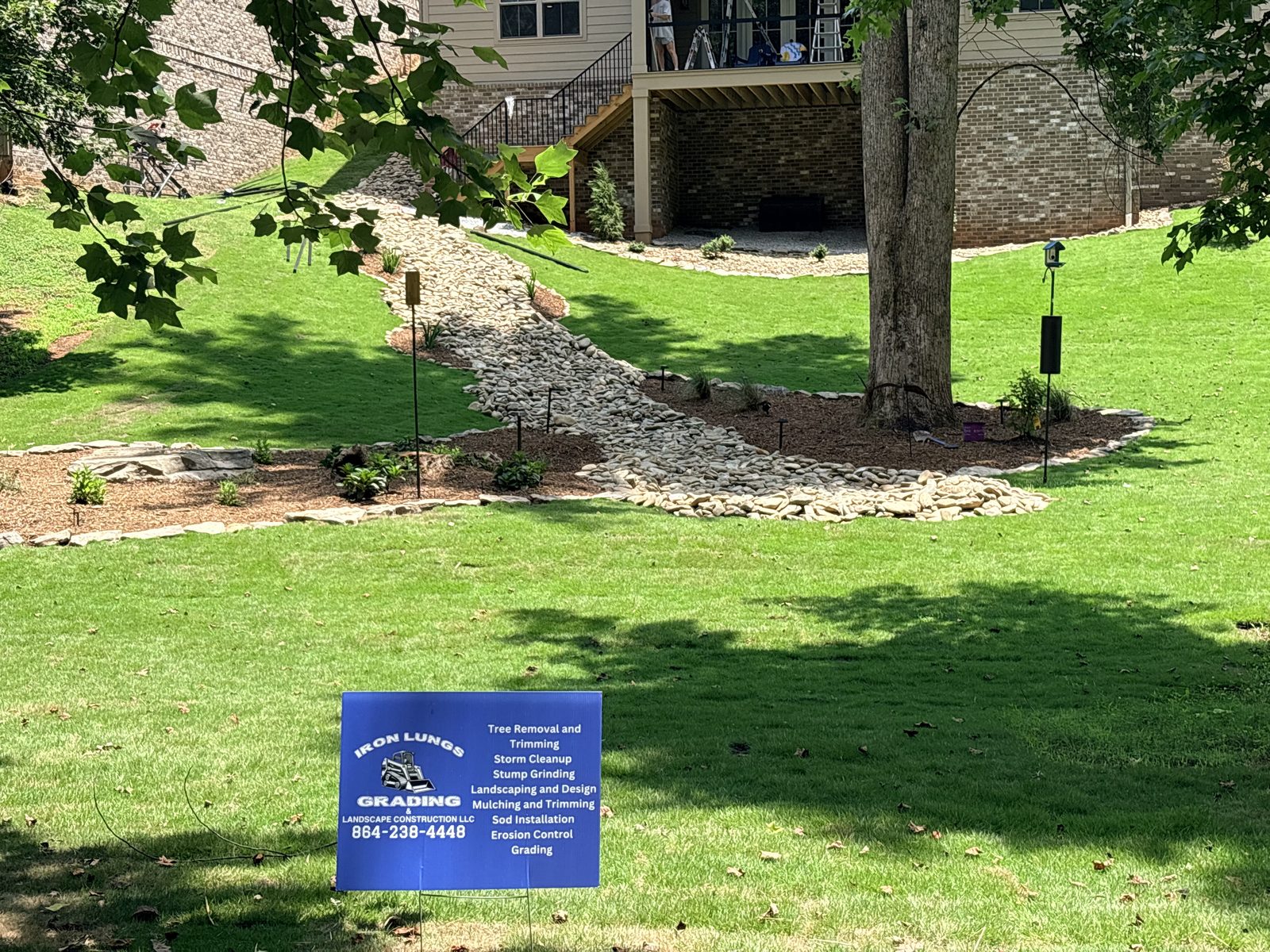
Grade decides where water goes. This is the part that gets ignored, and it is the part we spend most of our time on. Water that runs off your property is water your plants never got. If a bed sits on a slope with the grade pitched away, that bed is drier than the rest of the yard no matter how much it rains. Correct the grade — shape shallow swales that slow water, break up the compaction layer, add a rain garden or a dry creek like the one pictured above that lets runoff pause and infiltrate — and the same plants that died last year thrive without irrigation. We have watched it happen on the same beds, with the same plant list, two seasons apart. See our land grading and erosion control pages for what that work involves.
The order that works: fix the ground, then pick the plants. Doing it the other way around is how you buy the same shrubs twice.
What "Drought Tolerant" Actually Means
Every plant on the list below needs regular water for its first one to three years. Every single one. "Drought tolerant" describes a plant's behavior after it has grown a root system deep and wide enough to reach moisture the top few inches of soil do not have.
| Plant Type | Time to Establish |
|---|---|
| Perennials & ornamental grasses | One full growing season |
| Shrubs | Two growing seasons |
| Trees | Two to three seasons — longer for larger caliper stock |
Skip that establishment period and you have an expensive plant with a rootball-shaped root system that will need watering forever. This is the single most common reason drought-tolerant landscaping fails in the Upstate.
Native Trees That Handle Our Clay
| Tree | Mature Size | Sun | Why It Works Here |
|---|---|---|---|
| Eastern Red Cedar Juniperus virginiana | 30–40 ft × 10–20 ft | Full sun | Evergreen. Rocky, thin, low-fertility clay is no problem. Best screening tree we plant. |
| Blackgum Nyssa sylvatica | 40–50 ft × 20–30 ft | Sun to part shade | Best fall color of any native shade tree. Handles soggy bottoms to dry upland slopes. |
| American Persimmon Diospyros virginiana | 35–60 ft × 20–35 ft | Full sun | Thrives in low-fertility dry soil. Alligator-hide bark, big wildlife value. |
| Sourwood Oxydendrum arboreum | 20–30 ft × 10–15 ft | Sun to part shade | Signature Upstate native. Wants acidic, well-drained ground — best on slopes. |
| Shumard Oak Quercus shumardii | 40–60 ft × 40–50 ft | Full sun | Serious shade tree. Handles clay, urban stress, and a wide pH range. Faster than most oaks. |
If we could plant one thing on every hard, dry, exposed site in the Upstate, it would be eastern red cedar. It handles heat, wind, and drought about as well as anything on this continent, and it makes a far better evergreen screen than Leyland cypress — which is overplanted here and prone to bagworms and canker. Female trees carry blue berry-like cones that cedar waxwings strip in a weekend.
For a shade tree, blackgum is the one people notice in October — scarlet, sometimes almost fluorescent. Plant it small; it has a deep taproot and resents transplanting at size. And if you have room for an oak, plant an oak. The ecological value of a mature Shumard is not matched by anything else on this list.
Native Shrubs Worth Planting
| Shrub | Mature Size | Sun | Why It Works Here |
|---|---|---|---|
| Yaupon Holly Ilex vomitoria | 15–20 ft (dwarf 3–5 ft) | Sun to part shade | Evergreen. Takes very wet or very dry soil, heat, poor drainage, hard pruning. Best boxwood substitute. |
| Wax Myrtle Morella cerifera | 10–15 ft × 8–10 ft | Sun to part shade | Fast semi-evergreen screening. Fixes its own nitrogen, so poor soil suits it fine. |
| Oakleaf Hydrangea Hydrangea quercifolia | 6–8 ft × 6–8 ft | Part shade | The most drought-resilient hydrangea. Four seasons of interest. Wants medium moisture and mulch. |
| American Beautyberry Callicarpa americana | 4–6 ft × 4–6 ft | Sun to dappled shade | Electric magenta berries in September. Tolerates neglect; not for deep shade. |
| Fragrant Sumac Rhus aromatica 'Gro-Low' | 2–3 ft × 6–10 ft | Sun to part shade | The answer for a hot, dry bank you do not want to mow. Holds slopes, shuts out weeds. |
Two honest notes. Yaupon holly and wax myrtle are South Carolina natives, but Coastal Plain and Sandhills ones — they were introduced to the Piedmont rather than growing here wild. They have earned their place in Upstate landscapes anyway, because almost nothing else takes this much abuse. And oakleaf hydrangea, while far tougher than the bigleaf hydrangeas that wilt every hot afternoon, is not a true dry-site plant; give it a spot with some moisture and keep three inches of mulch on it.
If you have an eroding slope in full sun, put fragrant sumac at the top of your list. The 'Gro-Low' selection spreads into a dense two-foot mass that holds soil and turns brilliant orange-red in fall.
Perennials & Pollinator Plants
| Perennial | Height | Bloom | Notes |
|---|---|---|---|
| Purple Coneflower Echinacea purpurea | 2–4 ft | June–September | The workhorse. Full sun, wants decent drainage. Leave seedheads for goldfinches. |
| Butterfly Weed Asclepias tuberosa | 1–2 ft | May–August | Monarch host plant. Deep taproot, hates wet feet. Give it your driest spot. |
| Black-Eyed Susan Rudbeckia fulgida | 2–3 ft | July–October | Takes clay better than most. Spreads into a real colony. 'Goldsturm' is the standard. |
| Blazing Star Liatris spicata | 2–4 ft | July–August | Vertical purple spikes, heavy butterfly traffic. Needs sun. |
| Threadleaf Coreopsis Coreopsis verticillata | 1–2 ft | May–September | Ferny texture, absurd flower count, asks for nothing. Shear midsummer for a second flush. |
| Rough Goldenrod Solidago rugosa 'Fireworks' | 2–3 ft | September–October | Critical late-season pollinator forage. And no, goldenrod does not cause hay fever — that's ragweed. |
One nursery tip worth knowing: Liatris spicata is the blazing star sold everywhere, and it is actually the most moisture-tolerant species in its genus. It performs fine here, but if you want the true dry-site blazing star, ask for Liatris squarrosa. Same for goldenrod — 'Fireworks' is the garden-center standard and prefers moderate moisture, while gray goldenrod (Solidago nemoralis) is the one that thrives on hard, poor ground.
Ornamental Grasses & Groundcovers
| Plant | Size | Sun | Why It Works Here |
|---|---|---|---|
| Little Bluestem Schizachyrium scoparium | 2–3 ft | Full sun | Blue-green in summer, copper-orange all winter. Tolerates nearly any soil. Flops in shade. |
| Pink Muhly Grass Muhlenbergia capillaris | 2–3 ft | Full sun | The pink cloud you see in October. Needs sharp drainage — plant high on heavy clay. |
| Switchgrass Panicum virgatum | 3–6 ft | Sun to part shade | Roots go several feet down. Excellent for stabilizing soil. 'Northwind' stays upright in storms. |
| Christmas Fern Polystichum acrostichoides | 1–3 ft | Part to full shade | The best answer for dry shade. Evergreen, deer resistant, holds soil on shaded slopes. |
| Carolina Jessamine Gelsemium sempervirens | 10–20 ft vine | Sun to part shade | The state flower. Fragrant yellow trumpets in late winter, evergreen year-round. Toxic if eaten. |
Want to see more of what we install, with photos? Our plant catalog covers the full range of shade trees, ornamentals, screening evergreens, shrubs, and perennials we work with across the Upstate.
Three Combinations That Work Here
The hot, west-facing slope. Fragrant sumac 'Gro-Low' as the backbone, little bluestem for structure, butterfly weed and threadleaf coreopsis for color, goldenrod for the fall, and an eastern red cedar at the top of the slope for height and evergreen mass. This planting takes a full afternoon sun beating on the worst soil on the property.
The driveway edge or hell strip. Reflected heat, compaction, road salt, and no irrigation. Pink muhly grass and little bluestem alternating, black-eyed Susan filling between, dwarf yaupon holly anchoring the ends. Nothing here needs babying.
Dry shade under existing hardwoods. The hardest condition in most Greenville yards, because established tree roots take the water first. Christmas fern is the backbone — it is the rare native that genuinely handles it. Beautyberry works along the dappled edges where real light gets through, and oakleaf hydrangea works where the shade is bright and you can keep mulch down. Be honest with yourself about this one: dry shade needs supplemental water and mulch through the first two years no matter what you plant. And never raise the soil grade over tree roots to make planting easier — it kills the tree slowly.
How to Plant So They Actually Live
1. Test drainage before you buy anything. Dig a hole one foot deep, fill it with water, let it drain, then fill it again and time the second fill. Under 4 hours means good drainage — plant anything on this list. Four to twelve hours is typical Piedmont clay; stick to the adaptable species and set plants slightly high. Still holding water after 24 hours? Do not plant there yet. You have a drainage problem, and no plant on this list will fix it. That is a grading conversation.
2. Dig wide, not deep. Roots spread out, not down, in the first years. Clemson recommends a hole at least twice — preferably up to five times — the width of the rootball, and no deeper than the rootball itself. A hole dug deep in clay settles, the plant sinks below grade, and it sits in a bowl of water. Set the plant so the root flare, where the trunk widens into roots, is at or one inch above the surrounding grade. Nearly every landscape tree we are called out to diagnose was planted too deep.
3. Do not backfill with straight compost. Filling a clay hole with rich, fluffy compost creates a bathtub: water flows into the amended pocket, hits the clay wall, and stops. Roots circle inside the nice soil and never venture into native ground. Backfill with the loosened original soil mixed with no more than 10 to 20 percent compost. If you are building a whole bed rather than setting one plant, amend the entire area instead — spread 2 to 3 inches of compost and till it into the top 6 to 8 inches across the full footprint.
4. Mulch correctly. Two to three inches of shredded hardwood or pine bark, pulled back three inches from the trunk — not piled against it. Mulch volcanoes hold moisture on the bark, invite rot and voles, and kill more trees in the Upstate than drought does.
5. Water deep and infrequent. Light daily watering trains roots to stay shallow, which is exactly backwards.
| Stage | Watering |
|---|---|
| Weeks 1–2 | Every 2–3 days. Slow soak at the base — hose on a trickle, 15–20 min per shrub, longer for trees. |
| Weeks 3–12 | Once or twice a week, deeply. |
| Rest of year 1 | Weekly during dry spells. Skip weeks with a real soaking rain. |
| Year 2 | Every 10–14 days, summer dry stretches only. |
| Year 3 and after | Only in extended drought. |
Before you water, push a finger or a screwdriver into the soil three to four inches down. If it is damp, wait.
6. Plant in fall. October and November are the best planting months in the Upstate, and it is not close. The soil is still warm so roots keep growing, the air is cool so top growth is not demanding water, and winter and spring rain does most of the establishment watering for you. A fall-planted shrub enters its first summer with six months of root growth already banked. Spring planting works; summer planting means hand-watering through the hottest part of the year.
What to Avoid
| Skip This | Why |
|---|---|
| Bradford / Callery pear | Invasive and weak-wooded — it splits apart in storms. South Carolina banned its sale as of October 1, 2024. |
| Nandina (heavenly bamboo) | Invasive, and the berries are toxic to cedar waxwings. |
| Chinese privet | Already one of the worst invaders in Upstate woodlands. |
| Leyland cypress | Not invasive, just a bad long-term bet. Shallow-rooted, disease-prone, blows over. Eastern red cedar does the job better. |
Worth knowing: crape myrtle and Chinese pistache appear on nearly every "drought-tolerant Southern plant" list, and both are genuinely tough. Neither is native. That is fine if durability is all you want — but if the goal is supporting local pollinators and birds, natives do measurably more work.
When It's a Plant Problem vs. a Ground Problem
Choose plants yourself if your yard drains reasonably, the grade moves water away from the house without cutting channels, and things you plant generally live. Bring in equipment when you are seeing standing water 24+ hours after rain, bare eroding channels or exposed roots on slopes, water moving toward the foundation or crawlspace, turf and shrubs failing repeatedly in the same spot, a new-construction lot where nothing has ever really grown, or a slope too steep to plant or maintain safely.
Those are grading, drainage, and erosion control problems. Plants are the last step, not the first — and putting them in before the ground is right is the most common way people in the Upstate spend money twice. If you are also thinking about turf, our sod installation guide covers which grasses handle our clay and sun.