Can You Grade a Lot in Winter in the Upstate? —
Yes. Here's When We Do, and When We Wait
Every January we get the same call from Simpsonville, Greer, and Travelers Rest: "Should I just wait until spring?"
Usually the person asking has a lot that's been sitting since closing, a backyard that turned into a pond in December, or a builder who needs a pad ready by March. And almost always they've read advice written for somewhere the ground freezes solid and earthwork honestly stops for the winter. That advice doesn't apply to the Upstate, and following it costs people the best grading window of the year.
This guide covers what winter actually gives you, the one thing it takes away, how we decide on any given morning whether to run the machine, and what Greenville County and the state need from you before the first bucket goes in the ground.
Does the ground freeze in the Upstate? Not enough to matter
The reason earthwork stops for winter in the northern states is frost depth. When the ground freezes a few feet down, you can't cut it, you can't compact it, and anything you build on it heaves in the thaw. That's a real constraint — somewhere else.
In the Upstate, the building code's frost line — the depth a footing has to reach so freezing can't lift it — is 12 inches. York County publishes it plainly in its Table R301.2 design criteria, alongside a 10-pound snow load and a "moderate" weathering class, and the rest of the Upstate is in the same range. What that means on the ground: a handful of mornings each winter, the top inch or two of a Greenville lot is crusted hard. By mid-morning it isn't. The South Carolina State Climatology Office puts the median first fall freeze at the Greenville-Spartanburg airport at November 4 and the median last spring freeze at April 4, with a 213-day freeze-free season between them (SC State Climatology Office, Freeze/Frost Occurrence Data). Those are air temperatures at 32°F overnight — not frozen ground. We've never lost a full day to frozen ground in Greenville County. We lose days to water.
What winter gives you
1. You can see the ground. With the leaves down and the grass dormant, every low spot, every flow path, every place the previous owner "fixed" with a load of topsoil is visible from the driveway. In June the same lot hides most of that under thick turf and dry dirt. We wrote a whole guide on reading a yard during a hard rain; winter is when that reading is easiest to do and easiest to act on.
2. There's nothing to protect. Dormant warm-season turf doesn't care about equipment the way a growing lawn does, beds are cut back, and nothing is blooming. Clemson's lawn establishment guidance notes that "winter sodding is done when conditions for root growth are not favorable" (Clemson HGIC, Lawn Establishment) — which is exactly the point. Winter is for the dirt. Spring is for the grass. Doing them in that order is how you get a lawn that lives.
3. The grade gets tested before it matters. A lot graded in January takes three or four real rains before a footing is poured or sod goes down in April. If water is still finding the foundation after the first one, we fix it while the machine is still on site. A lot graded in May gets tested by the first thunderstorm after the sod is rooted, and the fix means tearing it up.
4. You're first in line for spring. Clemson recommends a soil test "2-3 months before the anticipated planting or seeding date" (same source). A lot graded and tested in January is ready for amendments in March and sod in April — the first warm week, not the sixth, when every sod crew in the Upstate is booked three weeks out.
Is winter the wet season in the Upstate? Not by rainfall — by what stays
Here's the part most "best time to grade" articles get wrong, in both directions. Winter is not the wet season in the Upstate — not by rainfall. The National Weather Service's long-term monthly table for Greenville-Spartanburg puts the normal at 47.19 inches a year, spread almost evenly: 4.11 inches in December, 3.82 in January, 3.97 in February, 4.52 in March. July, at 4.80, is the wettest month on the table (NWS Greenville-Spartanburg, Monthly Precipitation 1893–Present).
What changes in winter is not how much rain falls. It's that the rain stays. The 1991–2020 normals for the same station put January's mean temperature at 42.5°F with an average high of 52.8°F; July's mean is 79.7°F with an average high of 90.3°F (NWS GSP, January Normals; July Normals). Half the heat, a sun that's low in the sky for a short day, and nothing growing to pull water up through its roots — evaporation and plant uptake, the two things that dry a soil out, both slow to a crawl. Three inches in July is gone from the top foot of soil in days. Three inches in January sits.
And what it sits in is red clay. The soil under most Upstate lots is the Cecil series — the USDA's official description puts a layer of "red (10R 4/8) clay" from roughly 8 to 26 inches down, weathered in place from granite and gneiss, on slopes of 0 to 25 percent (USDA-NRCS, Official Series Description: Cecil). On paper it's "well drained." In practice, that red layer is the one the machine is sitting on once the topsoil is stripped, and it takes on water slowly: Cornell's soil hydrology reference puts the steady infiltration rate of "silty clay loams & clay soils" at less than 0.2 inches per hour, and notes that "bare soils may easily develop crusts" that cut it further (Cornell NRCCA, Soil Hydrology). A stripped, graded lot is bare soil by definition. Whatever falls on it in January is mostly still there in the morning.
Wet clay under a track loader does two things. It ruts, which is cosmetic. And it compacts, which is not. University of Maryland Extension lists "compression by construction equipment" and working "wet soil" as the primary causes of compaction, and states plainly that "correction of soil compaction is difficult" (UMD Extension, Problems Caused by Compacted Soil). NC State's guidance for Piedmont soils adds that "compaction from construction and traffic can reduce infiltration rates drastically" (NC State Extension, AG-439-70W). In other words: grade a lot wet and you build the drainage problem you were hired to remove, a foot below where anyone can see it.
A lot graded wet looks finished the day the crew leaves and fails the first spring. The grade is right. The ground under it isn't.
So how long after a rain is long enough? Iowa State's engineers measured exactly this for utility work on wet ground and found that well- and moderately-drained soils "reached field wetness after about three days of drainage" — field wetness being the point where the soil can carry equipment without excessive compaction (Iowa State University, Minimizing Excessive Soil Compaction, 2023). Poorly drained ground held its water longer. That matches what we see on Cecil clay: two to three dry days after a soaking rain on a well-drained lot, longer in a low spot or anywhere the subsoil is exposed.
How we read the ground on a winter morning
We don't grade by the calendar. We grade by what the first track print tells us. This is the actual decision, and it takes about thirty seconds.
| What the first pass shows | What it means | What we do |
|---|---|---|
| Track leaves a clean print, no water in it, soil crumbles at the edge | At or below field wetness | Run. This is a grading day. |
| Print holds water, or the soil smears and shines instead of crumbling | Above field wetness | Work the high ground only, or wait a day. No cuts in the low areas. |
| Ground moves under the machine — ruts "pump" and the surface rolls ahead of the track | Saturated | Stop. Nothing good happens today. We'd rather lose the day than compact the lot. |
| Hard crust at 7 a.m., soft by 10 | Surface frost only, an inch or two deep | Start late. With a 12-inch frost line this is cosmetic. |
| Standing water in the cut from the last rain | Trapped water, not necessarily wet soil | Ditch or pump it first. Never push wet material to "get rid of" a puddle. |
Swipe to see the full table →
This is our own field rule for Cecil-type red clay, informed by the Iowa State field-wetness work cited above. A contractor who runs on the second and third rows is building you a problem.
Month by month: what we schedule from November to March
Rainfall numbers are the NWS normals above. The rest is what a typical Upstate winter actually looks like from the seat of the machine.
| Month | Normal rainfall (GSP) | What the ground is doing | What we schedule |
|---|---|---|---|
| November | 3.70 in | Leaves down, soil still holding summer warmth, driest of the five months | Rough grading, land clearing, drainage correction, gravel driveways. The best grading month of the year. |
| December | 4.11 in | First frosts, ground wet between fronts | Grading between fronts; French drains and erosion control while the ground shows its flow paths |
| January | 3.82 in | Coldest month; surface frost most mornings, soft by mid-morning | Builder pads and full-lot grades; late starts; soil tests for April sod |
| February | 3.97 in | Wet and changeable; some of the best dry stretches of the winter arrive here | Finish grades for spring sod; drainage checks against real rain |
| March | 4.52 in | Wettest of the five; green-up begins late in the month | Finish grading and topsoil; first sod from late March. Schedule fills fast — book in January. |
Swipe to see the full table →
Rainfall normals: NWS Greenville-Spartanburg. Scheduling notes are ours, from Greenville County jobs.
Do you need a permit to grade a lot in Greenville County? It depends on area, not season
This is the part that trips up people who try to time a winter grade around a spring build. The rules are about how much ground you disturb, not when you do it, and the thresholds are published.
| Area disturbed | Greenville County | State of South Carolina |
|---|---|---|
| Under 5,000 sq ft (most backyard regrades) | Not addressed as a separate grading permit on the county's guidance; erosion controls still expected | No state coverage required |
| 5,000 sq ft to 1 acre, residential lot outside a permitted subdivision | The building permit can act in place of a separate Land Disturbance (Grading) permit, provided erosion controls (BMPs) are installed and maintained | Under 1 acre: a "Notification Form for Sites Disturbing Less Than 1 Acre" to SCDES, which issues a letter of exemption if coverage isn't needed |
| 1 acre or more, or part of a larger common plan of development | Land Disturbance (Grading) permit from the Land Development Division, plus a Notice of Intent to the state | Coverage under the NPDES Construction General Permit SCR100000: a stormwater pollution prevention plan, and site inspections no more than 9 days apart |
Swipe to see the full table →
County thresholds from Greenville County Land Development's "Do I need a permit?" guidance under Storm Water Management Ordinance No. 4698. State thresholds from the SCR100000 fact sheet and the SCDES under-one-acre page. The state's environmental programs moved from DHEC to the Department of Environmental Services in 2024, so older county documents still say "SCDHEC" — same rules, new name.
Two practical notes. First, the 9-day inspection clock on a permitted site doesn't pause for rain, so a winter job over an acre needs someone checking silt fence and inlets whether or not the machine is running. Second, "part of a larger common plan" means a single lot in a subdivision that's still being built out can fall under the one-acre rule even if your lot is a quarter of that. Your builder's permit usually covers it; ask before assuming. Permit fees are in the county's schedule, which we linked in our grading cost guide.
The winter grading sequence before a spring build or lawn
If you're planning a new lawn, a pool, an addition, or a full new-build yard for spring, this is the order that works. It's also roughly the order a good contractor will propose without being asked.
- Walk it in a rain first. Before anyone quotes anything, watch where the water goes. Our heavy-rain guide is a 10-minute checklist for exactly this.
- Soil test now. Clemson's 2-to-3-month lead time means a January test is back with lime and fertilizer recommendations in time for April sod. The Clemson Ag Service Lab runs them.
- Strip and stockpile the topsoil. Clemson's guidance for lawns needing extensive grading is to "remove the topsoil and stockpile it for replacement after the rough grade is established" (Clemson HGIC). We do this on every full-lot grade. Topsoil that gets buried under clay is topsoil you paid for twice.
- Rough grade on dry days. Set the falls away from the house. The residential building code, IRC R401.3, requires the ground to drop "at least 6 inches within the first 10 feet" away from the foundation, and allows swales or drains where lot lines make that impossible (IRC R401.3, via InterNACHI). Cut the swales where the water already wants to go — we cover how to find that in the drainage guide.
- Drainage while the ground is open. French drains, buried downspout lines, and outlet stone go in now, when a trench costs a fraction of what it costs through a finished lawn. Our erosion and drainage page covers the options.
- Let it take a rain. Then walk it again. Anything still pooling gets fixed while the machine is on site.
- Finish grade and return the topsoil in late February or March, once the subgrade has proved itself.
- Sod or plant when the soil warms. Clemson puts warm-season sod in "mid-late spring or in the fall"; our sod timing guide has the month-by-month detail for fescue, zoysia and bermuda.
What that sequence looks like on a real lot
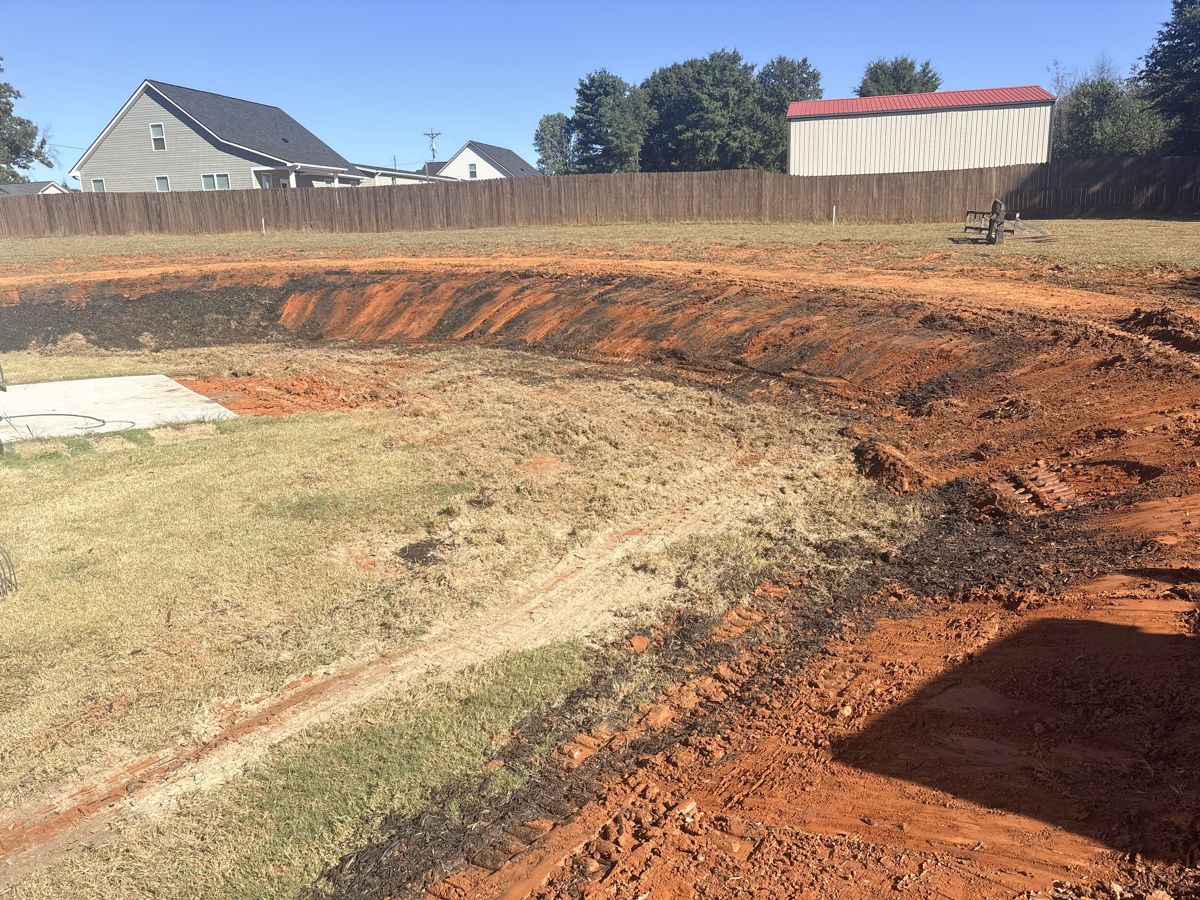
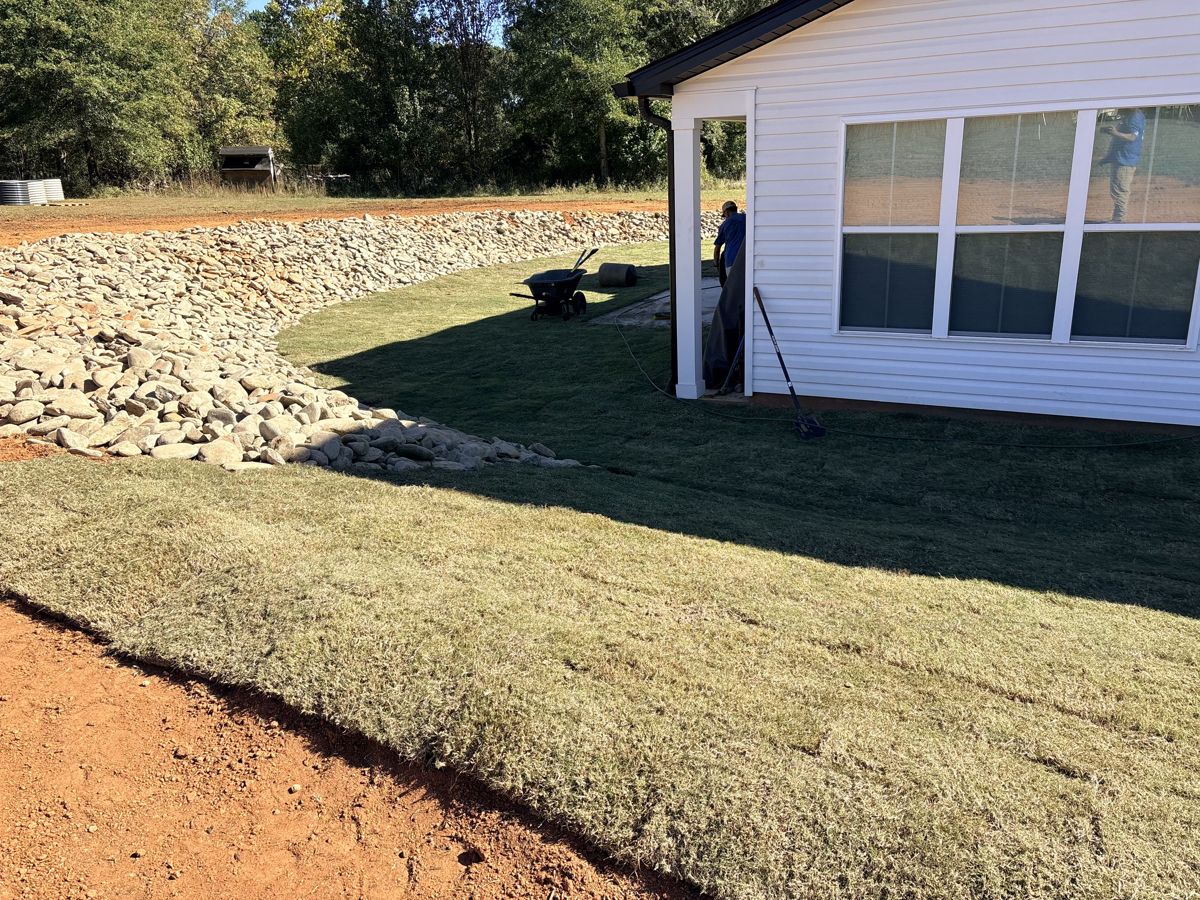
In the third week of October 2026 we ran exactly this sequence on a builder-grade home in Williamston, in Anderson County. It's the lot in the photos on this page, and it had three problems stacked on top of each other — all three common on new builds across Anderson and Greenville counties.
First, the back slope. Behind the house was a deep bank with a soft top: fill that had never been properly compacted, dressed in mulch that moved every time it rained. Second, the swale. At the crest of that slope the builder had cut a swale meant to carry water around the hill. It had never been graded to fall, so it held water and sent it over the edge instead of around it. Third, the whole lot. From the road to the back of the house, the ground was negatively graded — sloping toward the house rather than away from it. Every rain ran at the back wall, and the slope above delivered more.
Grading came first, and it was all of it: the top of the hill, the swale, the backyard, the base of the slope, and the front yard out to the road, so that every surface on the lot fell away from the house for the first time. Then the part grading can't do alone. A hill that drains onto a house will keep draining onto it no matter how the lawn is shaped, so we trenched French drains along the toe of the regraded slope — filter fabric, washed stone, perforated pipe — cut to fall, running around the house and daylighting into the regraded ditches at the road. Anything that comes off that slope now gets caught at the bottom and carried away before it reaches the foundation. The slope itself went from mulch to rock: a permanent surface that doesn't wash, doesn't need replacing every spring, and lets the water through to the drain beneath it.
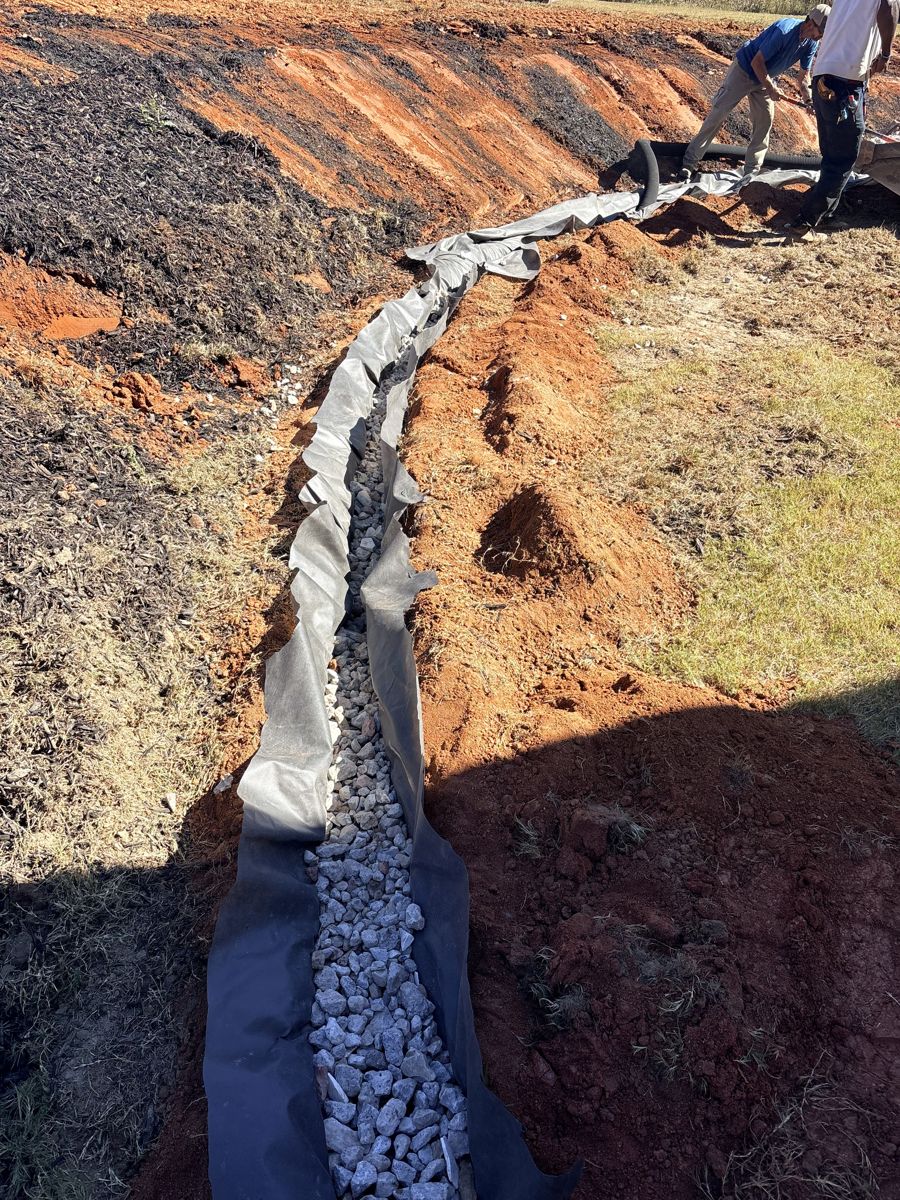
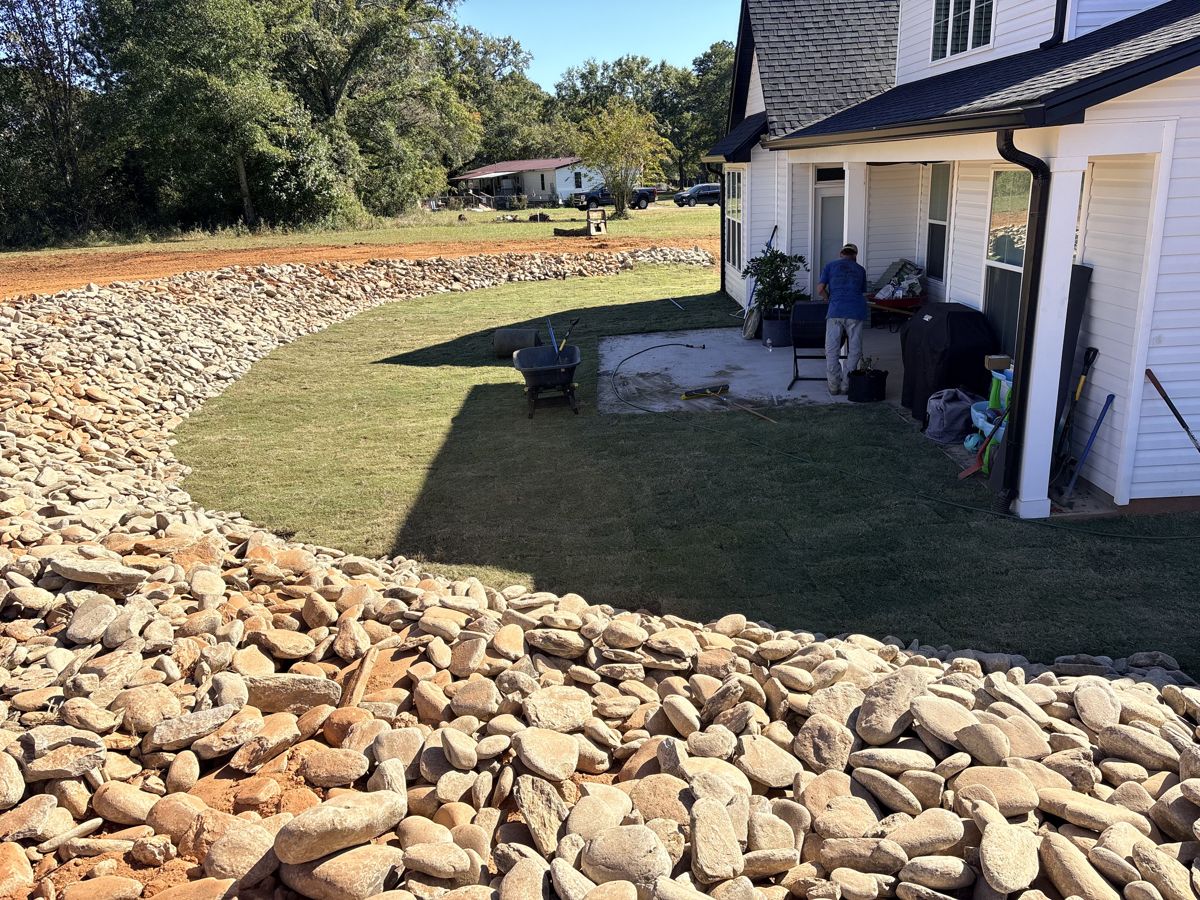
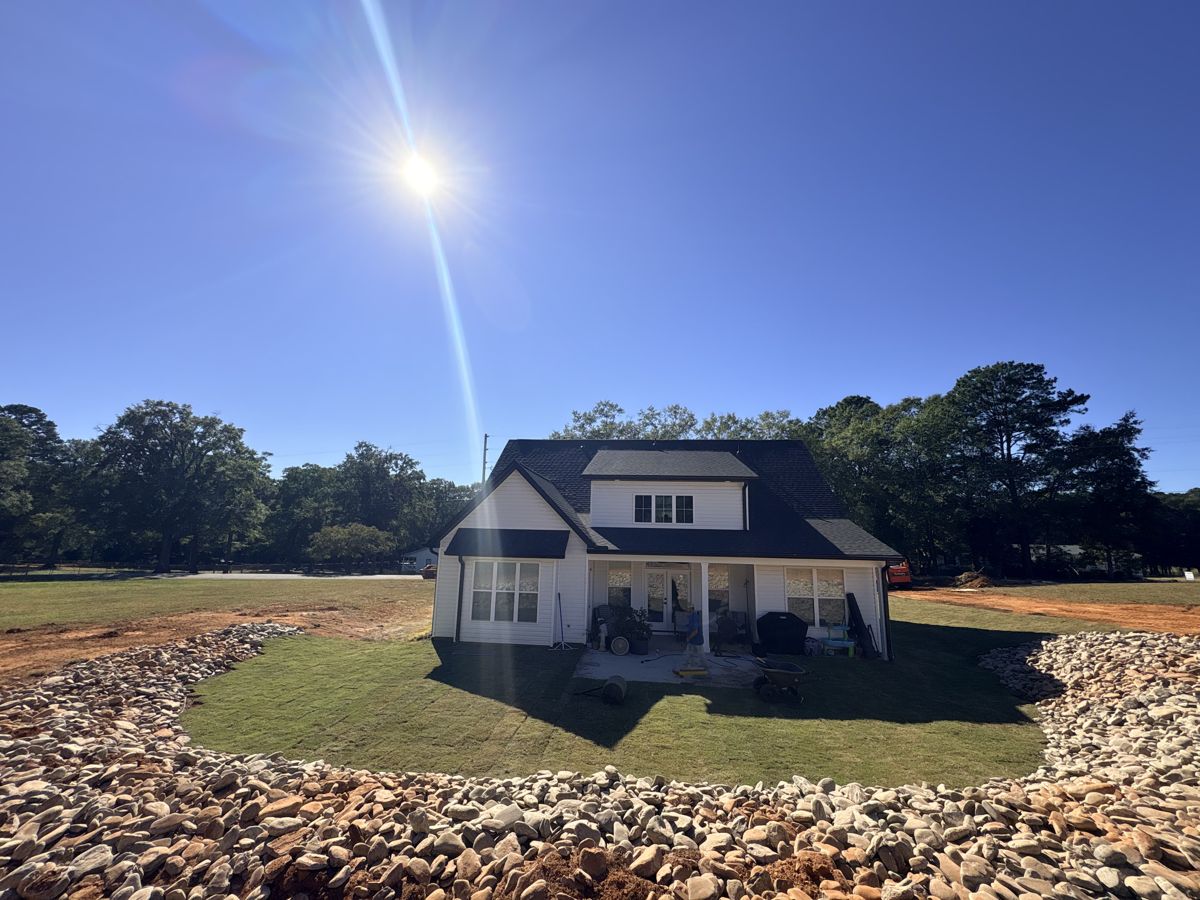
Two things about that job are worth noticing. The whole thing — regrade, drains, rock, sod — ran inside one dry stretch, because we scheduled it against the forecast and not the calendar. And a lot that was built wrong in the spring got fixed right in the fall, with the ground visible and nothing to protect. Three months from now it will have been through a dozen winter rains, and we'll know, not guess, that the water goes where it should.
The calls that come in the third week of March are almost all from people who decided in December to wait. By then the sod crews are three weeks out, the first thunderstorms have already shown the yard's problems, and every grading contractor in Greenville County has a full April. The people who called in January have grass. We'd rather you be one of those.
What winter grading costs
Our rates don't change by season. A finish grade is priced per square foot and a full regrade by the job, and the ranges in our 2026 Greenville grading cost guide apply in January exactly as they do in June. What does change is lead time — in winter we can usually walk a property within days and schedule within a week or two, where April and May run several weeks out.
The real saving in winter isn't a discount. It's not paying to regrade a lot that was done wet, and not paying for sod that died on a grade that was never tested.
The bottom line
The Upstate's winter is mild enough to grade through and wet enough to demand patience. The frost line is a foot. The ground is visible, the turf is dormant, and a grade finished in January gets proven by real rain before anything is built on it. The only rule is the one most people skip: stay off red clay for two or three days after it soaks.
If you've got a lot sitting, a yard that ponded last month, or a build coming in spring — the best time to grade it is the next dry stretch, not the next season.
Iron Lungs Grading & Landscape Construction grades lots, builder pads and backyards, corrects drainage, and prepares sites for sod and construction across Greenville, Simpsonville, Greer, Taylors, Travelers Rest, Mauldin, Easley, Williamston, Anderson, Spartanburg, and the surrounding Upstate — through the winter, between the rains. See our land grading page and new construction landscaping page, or call (864) 238-4448.